
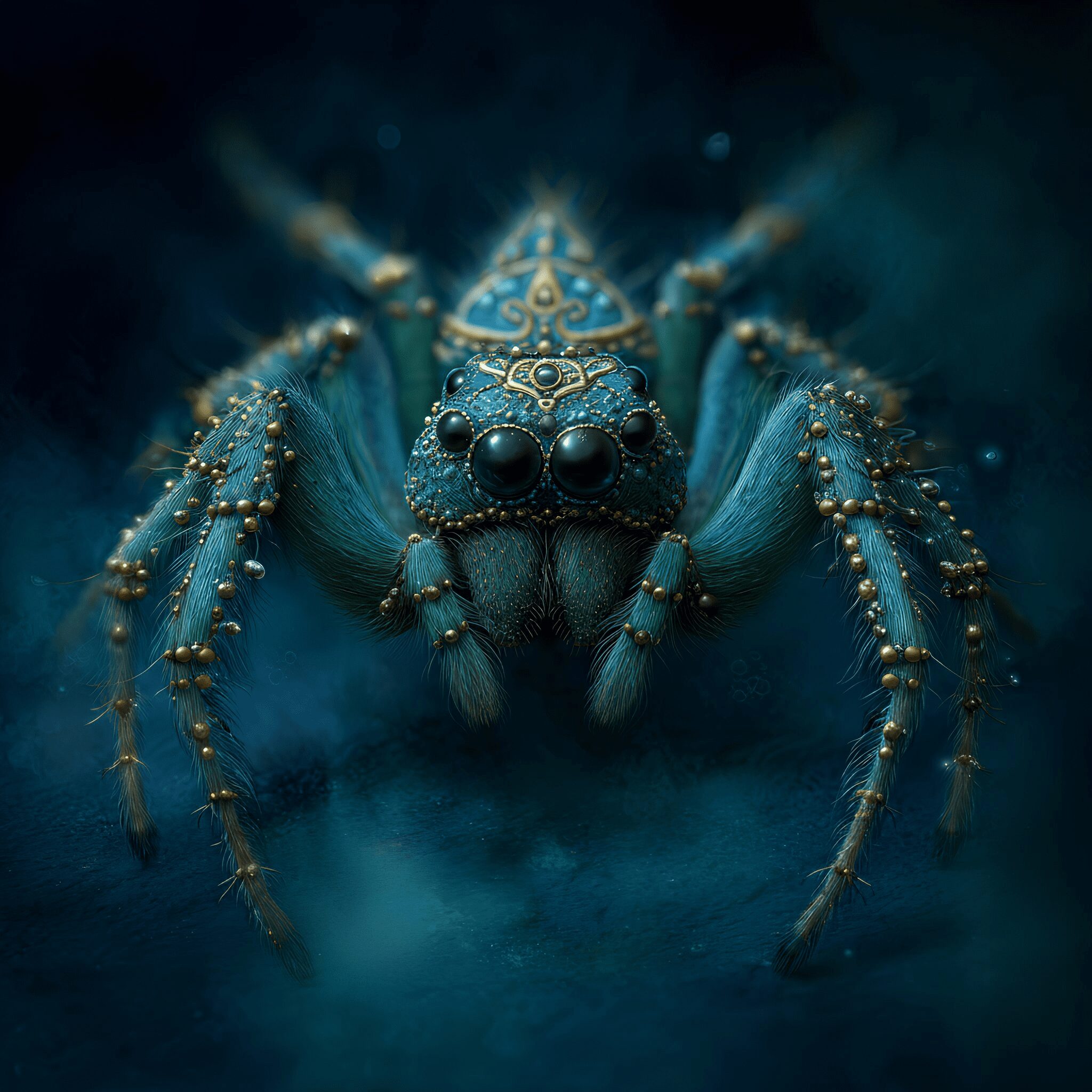

Assembly Instructions
To build a spider you need the following: eight jointed legs with vibration sensors on each one. A body divided into two parts that don’t communicate internally. Between six and eight eyes, most of them useless. Glands capable of producing up to seven distinct types of silk — some stronger than steel, others more elastic than nylon — depending on the function: hunting, wrapping, walking, protecting eggs, building shelter, attracting a mate, floating through the air. A circulatory system that runs not on red blood but on blue hemolymph. A brain so large relative to its body that in the smallest spiders it overflows the cephalothorax and fills part of the legs.
A brain that reaches into the legs. It thinks with its hands. Literally.
And one more thing: include the instinct to destroy what you build each night and reconstruct it at dawn. Because the orb-weaving spider — the one that makes the perfect circular webs you see on autumn mornings — eats its own web at the end of each day to recycle the proteins and spin a new one from scratch. Every night. For its entire life.
That is not an animal. It is a philosophy with legs.
Four Hundred Million Years Before the First Web
Spiders have been on Earth for roughly three hundred and eighty million years. But they didn’t always weave. The first spiders made no webs at all. They used silk only to line burrows and wrap eggs. It took them two hundred million more years to invent the aerial web — that engineer’s leap that turned silk into a suspended trap.
Two hundred million years to have an idea. And the idea worked so well that today there are more than forty-eight thousand species of spiders on the planet. They inhabit every continent except Antarctica. They live in your walls, in your garden, on the summit ridges of Everest at twenty-two thousand feet, in caves without a single photon of light, drifting on air currents three miles high. It is estimated that you are never more than ten feet from a spider, wherever you are.
Ten feet. The distance of a long embrace. And you never even know it.
Grandmother Spider Who Wove the World
For the Hopi and Cherokee peoples, the world exists because a spider wove it. This is not metaphor — it is literal cosmogony. Spider Woman, Kokyangwuti in Hopi, is the creator. Not a distant god issuing commands from above. A grandmother who sits and weaves. Thread by thread. With patience. With her hands.
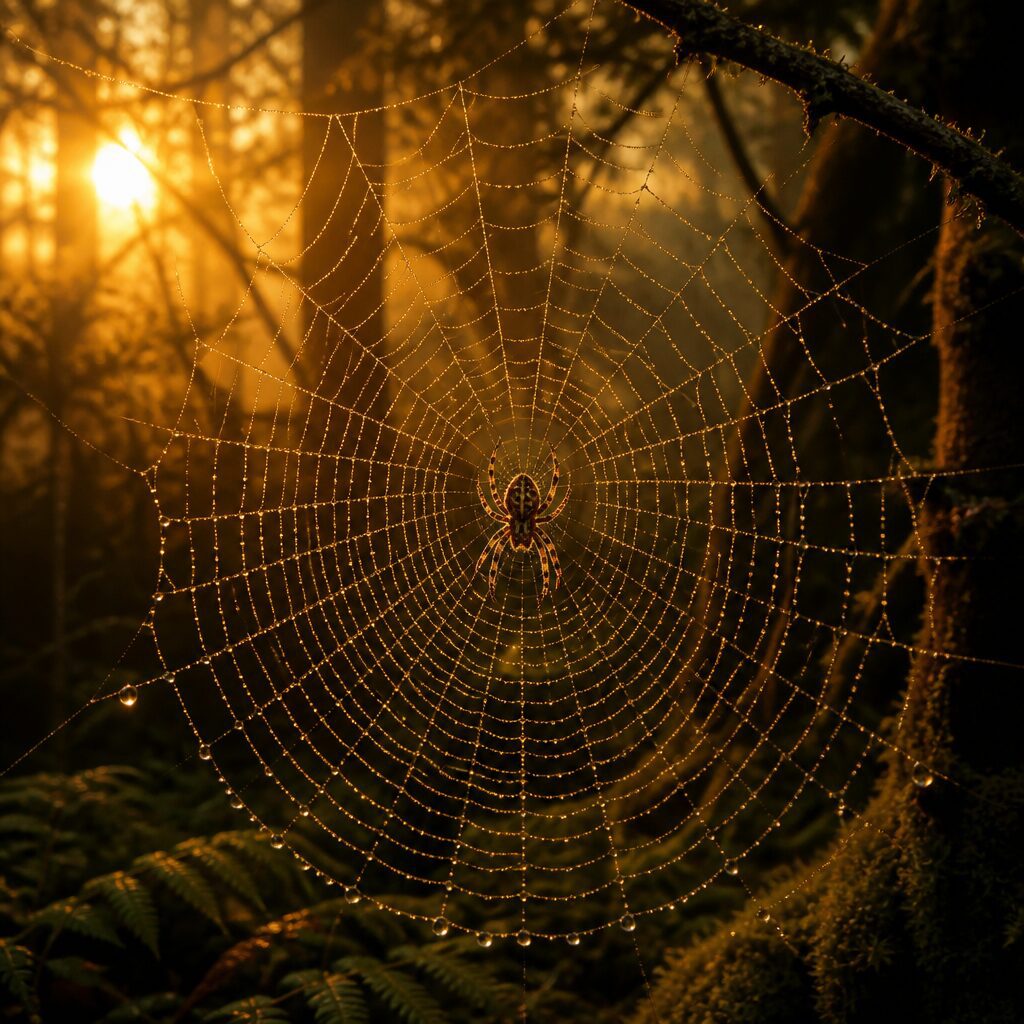
In Hopi tradition, Kokyangwuti created human beings by mixing earth with saliva and covering them with a blanket of wisdom — a woven thing. She gave them speech. She taught them to sing. And she warned them: if they forget the songs, the world will unravel.
The Navajo have Na’ashjé’ii Asdzáá — Spider Woman — who taught the Diné women the art of weaving. Navajo textiles, with their geometric designs recognized the world over, are reproductions of the spider’s original teaching. Every loom carries a deliberately loose thread — the spirit line — because Spider Woman said that a perfect weaving traps the soul of the weaver. The deliberate imperfection is the exit.
In West Africa, Anansi — the trickster spider of the Akan people of Ghana — stole all the stories of the world from the sky god Nyame. Not by force. By cunning. He captured a leopard, a python, a wasp’s nest, and an invisible spirit, using nothing but wit and silk. When he delivered all four to Nyame, the god gave him in return every story that exists. Since then, all stories belong to Anansi. Every time someone tells a tale, they are using something a spider won.
Enslaved Akan people carried Anansi to the Caribbean. In Jamaica he became Anancy. In Curaçao, Nanzi. The spider traveled on the slave ships because stories travel where bodies cannot. And on every island, the spider kept doing the same thing: outwitting the powerful with intelligence, not muscle.
Arachne, or What Happens When You Weave Better Than a Goddess
The story of Arachne, as told in Ovid’s Metamorphoses, is the story of a human weaver so skilled she challenged Athena to a contest. Athena wove a magnificent tapestry showing the power of the gods. Arachne wove one showing their abuses — Zeus seizing Europa, abducting Leda, deceiving everyone.
What Arachne wove was truth. And it was perfect. Not a single technical flaw. Athena could not find one.
So she struck her. And Arachne, humiliated, tried to hang herself. Athena, caught between guilt and rage, transformed her into a spider. “Since you love to weave so much, weave forever.”
This story is usually told as a warning against pride. But read it again. A woman with talent superior to the gods uses that talent to tell the truth, and is punished for it. She is turned into what they fear most: something that weaves truths that cannot be broken, in corners where no one wants to look. The spider is not the punishment. She is the most radical form of the artist: the one who keeps creating even when they have been made into a monster.
The Silk That Shouldn’t Exist
Spider silk is, by weight, five times stronger than steel and more elastic than nylon. A web the thickness of a pencil could stop a plane in flight. This is not exaggeration — it is materials physics, calculated by researchers at MIT.
What science has failed to accomplish in decades is replicate it. Not for lack of trying. The Canadian company Nexia Biotechnologies inserted spider genes into goats to produce silk in their milk. It worked, partially. The U.S. military has spent years funding research into spider-silk body armor. Japan wants it for surgical sutures. No one has matched what a garden spider does every night without thinking about it.
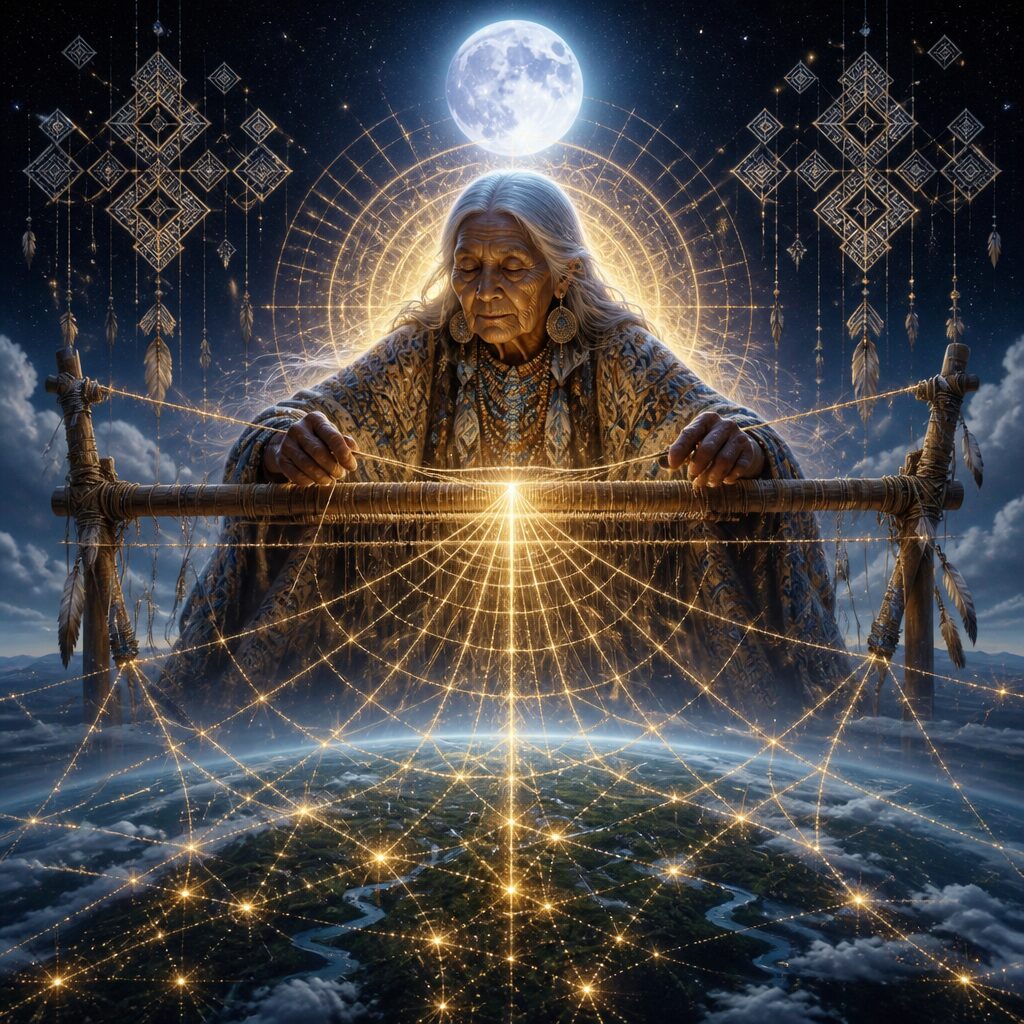
Because the secret is not just in the chemical composition. It lies in how the spider produces it — controlling pressure, speed, angle, and protein combinations — in real time, with a precision no machine can equal. The spider doesn’t manufacture silk. It plays it. Like a musician plays an instrument. Every thread is a decision.
Spiritually, this matters. The spider doesn’t tell you “create anything.” It tells you: create with the precision of someone who knows that every thread holds something up. That every word you speak, every choice you make, every relationship you weave, is a filament that forms part of a larger structure. And that the quality of that structure depends on the attention you bring to each individual thread.
The Spider’s Shadow
The weaver of traps. The same skill that creates can ensnare. The spider in shadow is the person who weaves networks of manipulation with the same elegance with which they should be weaving genuine connection. Who uses their intelligence to entangle, to control, to leave others stuck in a structure designed for their own benefit. Anansi was brilliant, but he was also a deceiver. There is a very thin line between cunning and manipulation, and the spider in shadow crosses it without blinking.
Caught in its own web. Ovid said it two thousand years ago: you can become prisoner of what you yourself built. Relationships that began as shelter and became a cage. Projects that stopped serving any purpose years ago but you keep maintaining because “I’ve already invested too much.” Stories about yourself that were once true but are now a sticky web that won’t let you move. The spider in shadow forgets that destroying the web each night is part of the cycle. That clinging to what has been built is the death of the creator.
Waiting instead of living. The spider builds its web and waits. It can stay motionless for hours, days. It is a brilliant predatory strategy. But transplanted into human life, it can become paralysis dressed up as patience. “I’m waiting for things to come to me.” “I’m waiting for the perfect opportunity.” “I’ve done my part; now it’s up to the universe.” The spider in shadow confuses strategy with passivity. The universe doesn’t work for you. It works with you. But you have to move the threads.
Venom as the first response. Most spiders are venomous. It is their hunting tool, not their weapon of aggression. But the spider in shadow bites first and asks questions later. It is the person whose first reaction to any threat — real or imagined — is to attack. Who injects toxic words, poisoned silences, aggression disguised as “brutal honesty.” Venom exists to survive, not to control.
Those Who Walk with the Spider
Spider people are creators. Not necessarily artists — though many are. They are people who create systems, relationships, environments, solutions. Who see connections where others see emptiness. Who intuitively know how to join dots that seemed entirely separate.
They are extraordinarily sensitive to vibrations. Not the crystal-healing kind. Real vibrations: the shift in someone’s voice when they are lying, the tension that settles into a room before anyone speaks, the almost physical pull you feel when something is about to break. They feel the threads. Always.
Their intelligence tends to be more tactile than verbal. They think with their hands, like the spider whose brain reaches into its legs. They need to touch, to do, to build in order to understand. A book tells them less than an experiment. A theory tells them less than a prototype.
Their challenge is attachment to what they have woven. Learning that the web of this morning doesn’t have to be the web of tomorrow. That tearing down to rebuild is not failure but method. That the finest web in the world is worthless if it no longer catches what you need.
How to Connect with Its Medicine
Weave something with your hands. Literally. Sew, knit, tie knots, braid, build models, shape clay. The spider doesn’t think the web. It makes it. If you are stuck in a project, a decision, a feeling — stop thinking and start making something with your hands. The answer will come through your fingers, not your head.
Destroy a web. What structure in your life has already served its purpose? What habit, routine, relationship, or project do you keep maintaining only because you built it yourself? The orb-weaving spider eats its own web each night. Not with sadness. With hunger for what comes next. What web do you need to eat in order to have material to spin the next one?
Pay attention to the threads. Spend an entire day noticing the connections. The invisible threads between your decisions in the morning and your emotional state at night. The threads between what you said last week and what is happening today. The spider feels every vibration in its web. You can feel the vibrations in yours too. You just have to stay still long enough to notice them.
Leave one thread loose. The Navajo know it: the perfect weaving traps the soul. Whatever you are creating — a plan, a project, a version of yourself — leave one deliberate imperfection. A space through which what needs to leave can leave, and what needs to enter can enter. Perfection is a trap. The loose thread is the door.
The Thread You Cannot See
In 2009, a team of researchers from the Natural History Museum in London and the American Museum of Natural History accomplished something no one had attempted before: collecting silk from more than one million Nephila spiders from Madagascar — golden orb-weavers — to weave a cloth measuring eleven feet by four feet. It took four years. Eighty people worked on the extraction, spider by spider, thread by thread. No animals were harmed — the spiders were collected, their silk gently drawn out, and they were returned to the wild.
The result is a piece of pure spider silk, naturally golden in color, that shines as though it carries its own light. It is the only large-scale textile made entirely of spider silk in existence. It was exhibited at the Victoria and Albert Museum in London.
One million spiders. Four years. Eighty people. For eleven feet of cloth.
That tells you something about what it costs to create something that truly matters. About the patience it requires. About how many hands — how many legs — are needed. About the beauty of what happens when a thousand invisible threads come together into something that glows.
And about the spider itself: that it has been weaving in silence for three hundred and eighty million years. That most of its webs last a single day. That ninety-nine percent of what it builds is destroyed, torn, carried away by the wind. And that at the next dawn, it begins again. Without resentment. Without grief. With the same precision as always.
That is not resilience. It is something that still has no name in any language. Something only spiders know how to do — and that you, if you pay attention, can learn.