
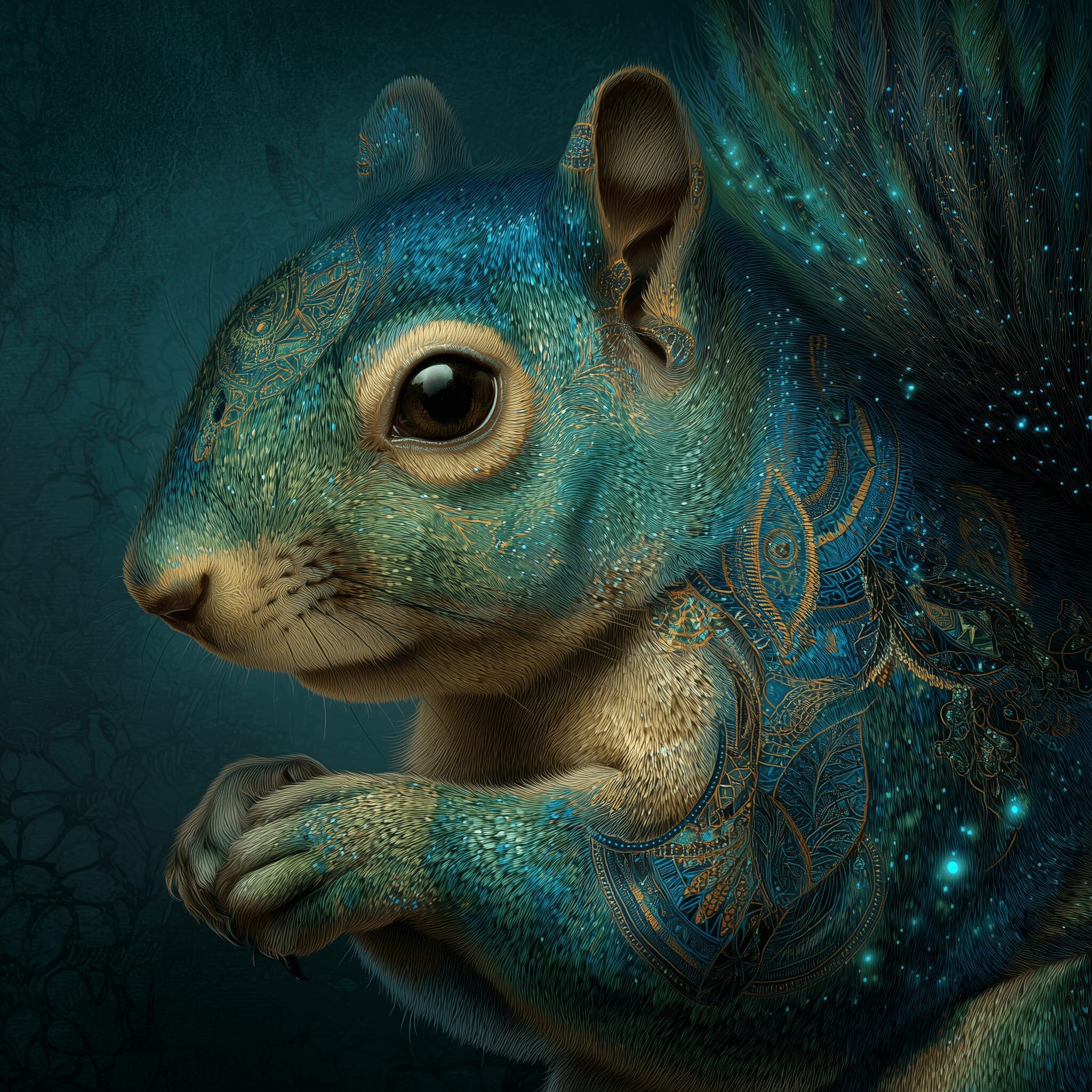

If a gray squirrel buries 10,000 acorns every autumn and forgets where it put 74% of them, how many new oak trees grow each year because of its terrible memory?
The answer is: millions. Entire forests.
The squirrel doesn’t plant trees. It forgets where it hid its food and the trees plant themselves. It is the most efficient reforester on the planet and has absolutely no idea that it is. A study by Rob Swihart at Purdue University (2001) estimated that gray squirrels are responsible for dispersing more oak seeds than any other animal in North America. Every oak forest you see exists, in part, because a squirrel couldn’t remember.
Productive forgetting. Failure that becomes forest. If that isn’t a spiritual teaching, revisit your definition of spirituality.
The Messenger Nobody Took Seriously
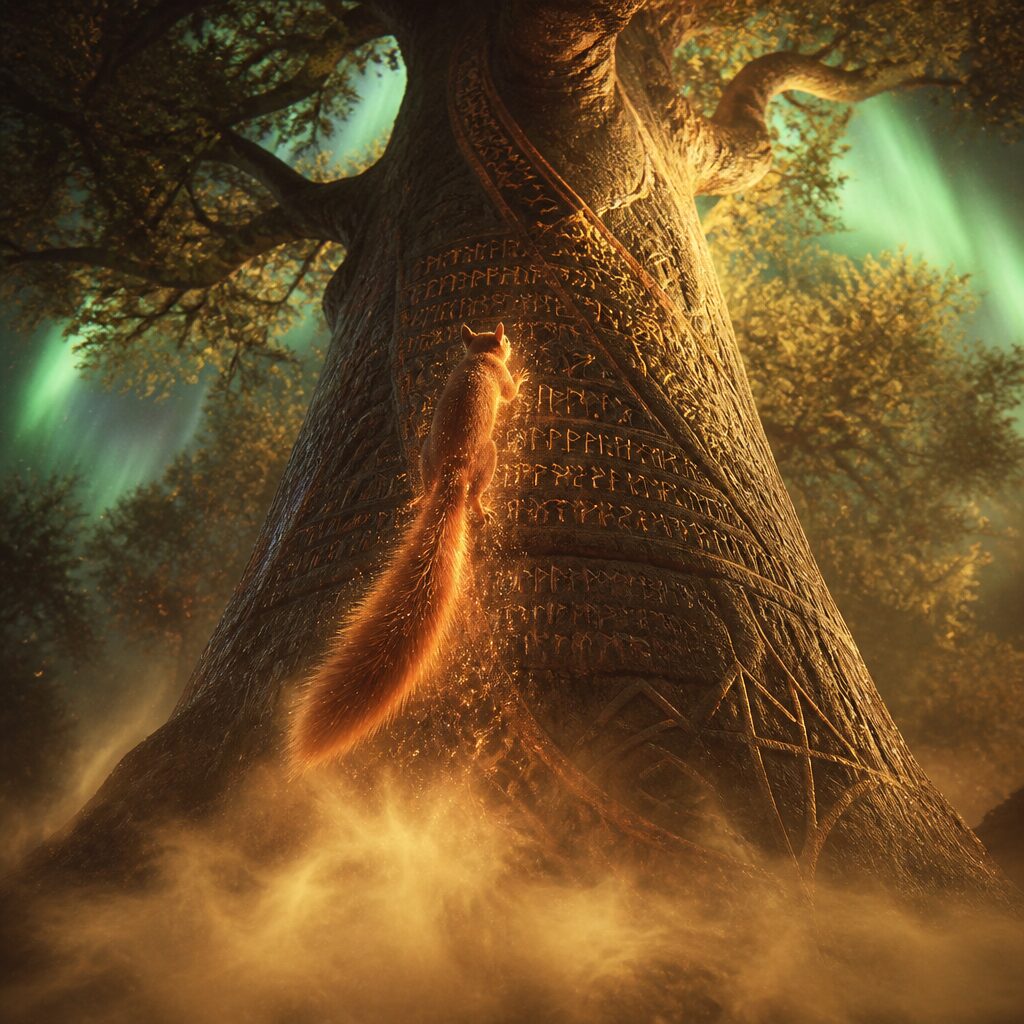
The Norse took it very seriously. Ratatoskr — “tooth-driller” — was the squirrel that ran up and down the trunk of Yggdrasil, the world tree, carrying messages between the eagle living in the crown and the serpent Níðhöggr gnawing at the roots. The Prose Edda of Snorri Sturluson says Ratatoskr carried “words of malice” between them. It was no neutral messenger — it was an agitator. It fed the conflict between high and low, between vision and destruction.
That is the first clue: the squirrel connects extremes. It chooses no side. It runs up and down, carries and brings back, and the world tree stays alive because of the tension it stokes. Without Ratatoskr, the eagle and the serpent would forget each other. And a world without tension between vision and root is not a world in balance — it is a world asleep.
The Cherokee saw the squirrel as a teacher of preparation. In their stories, the squirrel is the one who warns the other animals about the coming winter when everyone is busy enjoying summer. It is not popular for this — nobody wants to hear the one saying “save for later” when everyone is celebrating. But when the cold arrives, the squirrel eats.
The Choctaw held a darker story. For them, the black squirrel was an omen of solar eclipse. When a black squirrel crossed your path, it meant something was about to go dark — temporarily. Not permanently. Eclipses end. But during that period of darkness, what you had stored within yourself was the only thing that would sustain you.
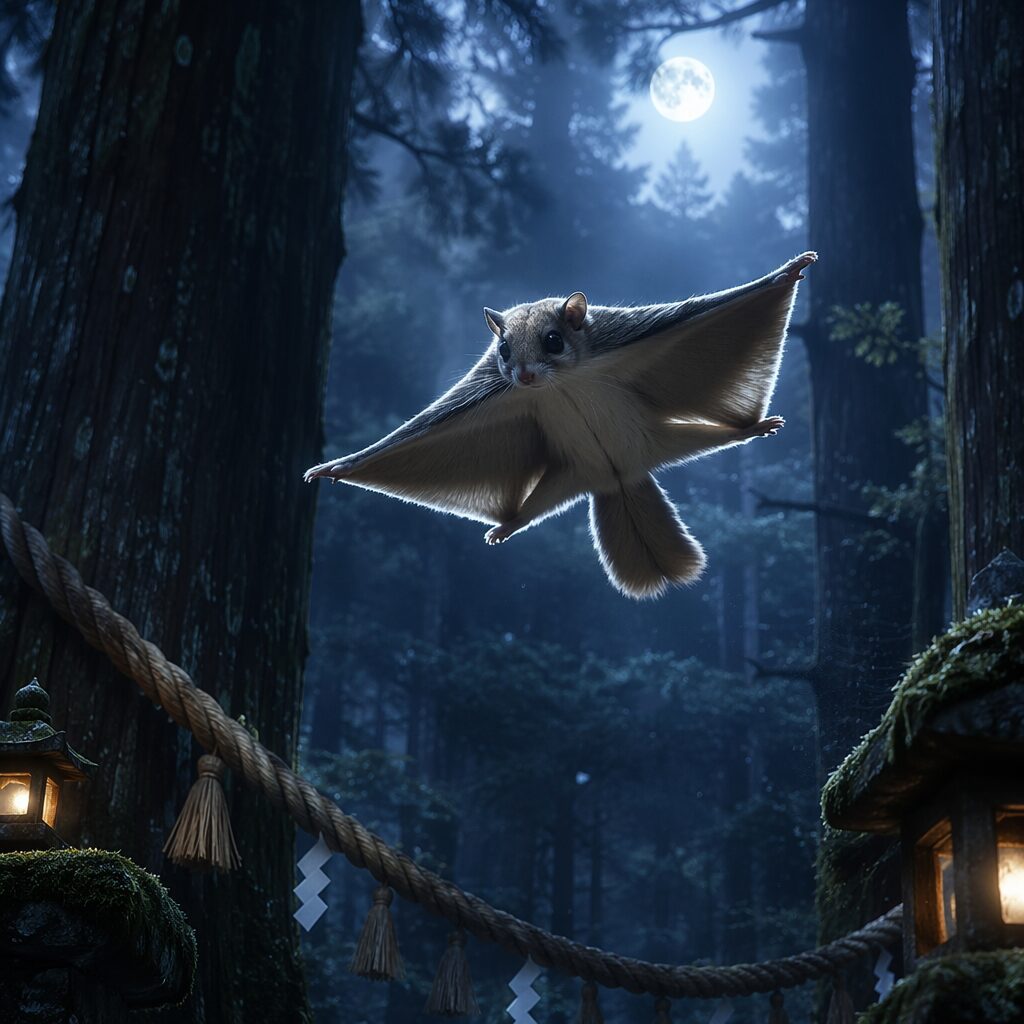
In Japan, the Japanese flying squirrel — momonga — is considered a forest spirit, a minor kodama. Shinto shrines in Hokkaido depict it as guardian of the spaces between the trees. Not of the trees — of the spaces between them. Of the emptiness that makes the forest possible.
In medieval European folklore, the red squirrel was associated with vanity and coquetry — probably because of that extravagant tail it uses as an umbrella, a blanket, and an alarm signal. Twelfth-century bestiaries drew it holding its tail over its head to shelter from the rain. That is not vanity: it is survival engineering. But the monks writing bestiaries saw sin in any animal that seemed to enjoy itself.
What You Store Defines You
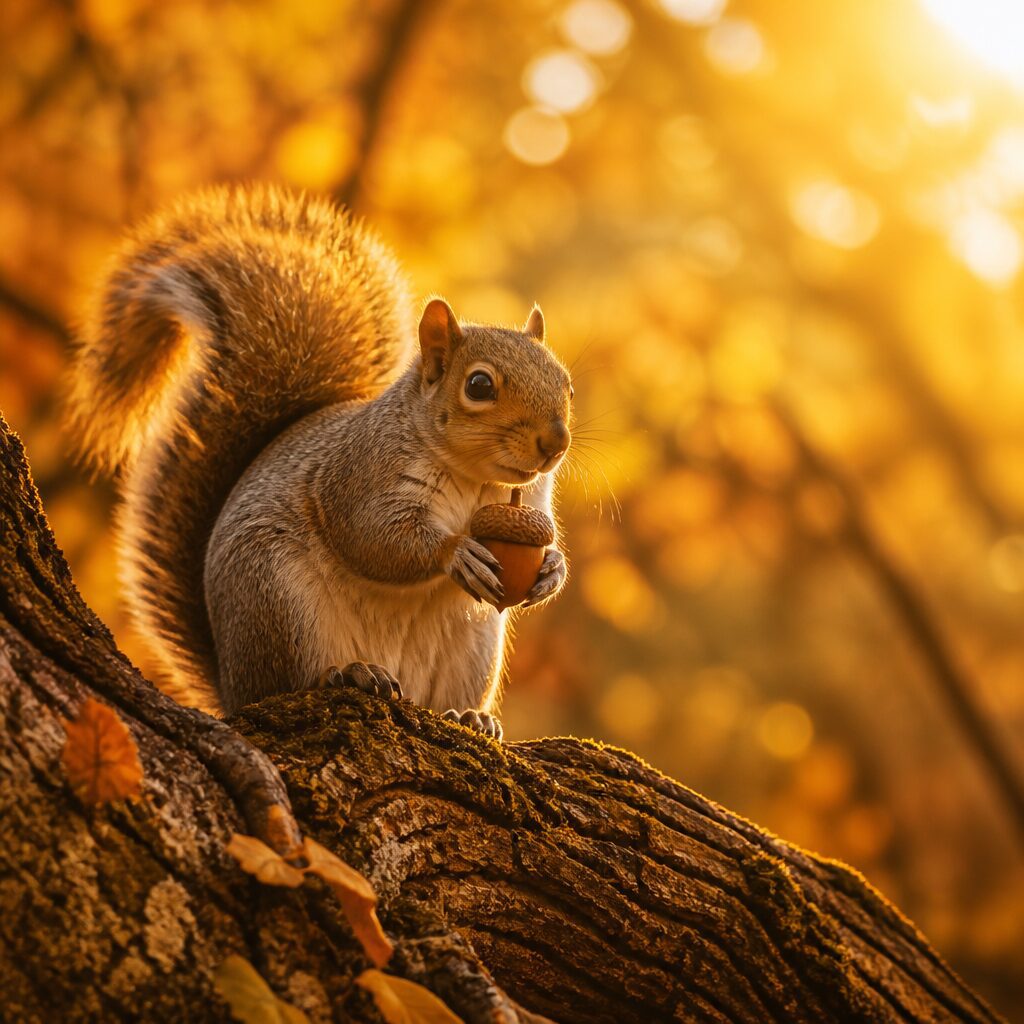
The squirrel buries between 3,000 and 10,000 nuts every autumn. Each one in a different location. It uses spatial memory, visual landmarks, and scent to retrieve them. Researchers at the University of Exeter (Pizzo Sherrill, 2017) demonstrated that gray squirrels organize their caches by nut type — walnuts, acorns, and hazelnuts go to different zones. It is not chaos: it is a system.
The squirrel’s first medicine: preparation as an act of faith. It doesn’t store out of fear. It stores because it trusts that there will be a future where it will need what it saves today. Every buried acorn is a wager that winter will end. That is radical optimism dressed as prudence.
The second: forgetting as a gift. That 74% it never retrieves becomes forest. The squirrel fails as a hoarder and succeeds as a sower. How many of your failed investments, abandoned projects, ideas that “didn’t work” are out there right now becoming something you can’t yet see?
And the third: energy as a finite resource that renews itself. The squirrel has two modes — frantic and dormant. No middle ground. When active, its metabolism burns more energy per gram of body weight than almost any other mammal. When it rests, it shuts down completely. It does not try to maintain a “sustainable” pace. It bursts, recovers, bursts again. It is the antidote to the fantasy of constant productivity.
The Noise You Mistake for Work
The squirrel has shadows you will recognize immediately.
The first is activity as anesthesia. The squirrel never stops. It runs, leaps, digs, climbs, spins. Observed from outside, it looks like the definition of productivity. But much of that activity is redundant: it unearths nuts to rebury them somewhere else, checks caches it already checked, jumps from branch to branch with no apparent direction. How much of what you call “being busy” is movement without destination? How many of your urgencies are squirrels leaping from branch to branch?
The second: chronic distrust. The squirrel trusts no one with its caches. It reburied nuts if it believes it was watched. It fakes burying food in one spot while actually hiding it in another — researchers call this “deceptive caching,” documented by Steele et al., 2008. Are you keeping secrets out of caution or paranoia? How much energy do you spend protecting things nobody wants to take from you?
The third shadow: accumulation as identity. The squirrel that stores too much and shares nothing. The person who has 47 browser tabs open, newsletter subscriptions they never read, online courses they never finish, books they never open. Storing is not the same as having. And having is not the same as using.
And the fourth: nervousness as a permanent state. The squirrel flicks its tail, swivels its head, chatters at every sound. Its nervous system is calibrated for hypervigilance. Translated to human terms: the person who lives in chronic low-grade anxiety, always alert, always waiting for something to go wrong, unable to relax because the imaginary predator never leaves. The squirrel has reasons to be nervous — a hawk can drop on it in any second. You probably don’t.
Those Who Live Among the Branches
If the squirrel is your power animal, you carry an energy that exhausts others long before it exhausts you.
Squirrel people are natural gatherers: of data, of experiences, of contacts, of skills. Your mind operates like a pantry with ten thousand compartments, each labeled and organized according to a system only you understand. When someone needs something — a fact, a contact, a reference — you have it. Always.
Your relationship with the future is different from most people’s. You don’t live in the present like the hummingbird, nor do you plan decades ahead like the elephant. You live in the near future: the coming weeks, the coming months. Your mind is permanently calculating what you will need and preparing to have it. That makes you extraordinarily resilient — and extraordinarily tense.
And you have a gift you underestimate: the ability to connect extremes. Like Ratatoskr between the eagle and the serpent, your natural function is to carry and bring back between worlds that don’t speak to each other. You are the bridge between departments, between people, between ideas that seem incompatible. That is far more valuable than you believe — and far more exhausting than you admit.
Burying Something Today
The most direct practice for connecting with the squirrel’s medicine is literal: bury something. Write an intention on paper — a project, a seed of something you want to exist six months from now. Put it in a jar, bury it in the earth, and forget it. Don’t dig it up. Don’t check on it. Leave it there and keep living.
The squirrel doesn’t guard every cache. It trusts that what it needs will be there when the time comes — and that what it forgets will serve some other purpose. Practice that trust.
Second practice: the cache audit. How many things do you have stored “just in case”? Files, clothes, ideas, commitments, relationships. Do a ruthless inventory. What you haven’t used in a year — release it. The squirrel that accumulates without limit is not wise — it is sick with fear. Your emotional pantry needs room for what’s new.
And third: play. The squirrel plays. It chases itself, leaps for no reason, does acrobatics on power lines. Ethologists call it “non-functional play behavior” — activity with no apparent survival purpose. It is the squirrel reminding you that not everything has to serve something. That joy without function is, in itself, function enough.
The Forest You Don’t Remember Planting
In 2019, a team from the University of Richmond led by Kelly Lambert trained six rats to drive small electric cars toward a food reward. But the interesting part wasn’t that they learned — it was that they preferred to drive even when they could get the food without doing so. They liked the process. The activity itself was the reward.
Squirrels do something similar. Researchers at the University of California Berkeley observed that ground squirrels play even in drought years, when food is scarce and energy should be conserved for survival. They play anyway. They bury nuts they don’t need. They run without direction. They chase each other.
There is something in that persistence of joy that biology cannot fully explain. Something that doesn’t fit the resource-optimization model or the selfish gene theory. Something that looks very much like what humans call spirit.
Ten thousand forgotten acorns. An entire forest where no one remembers who planted it. And a squirrel at the highest branch, looking down with absolutely no idea that all of this is its own.