
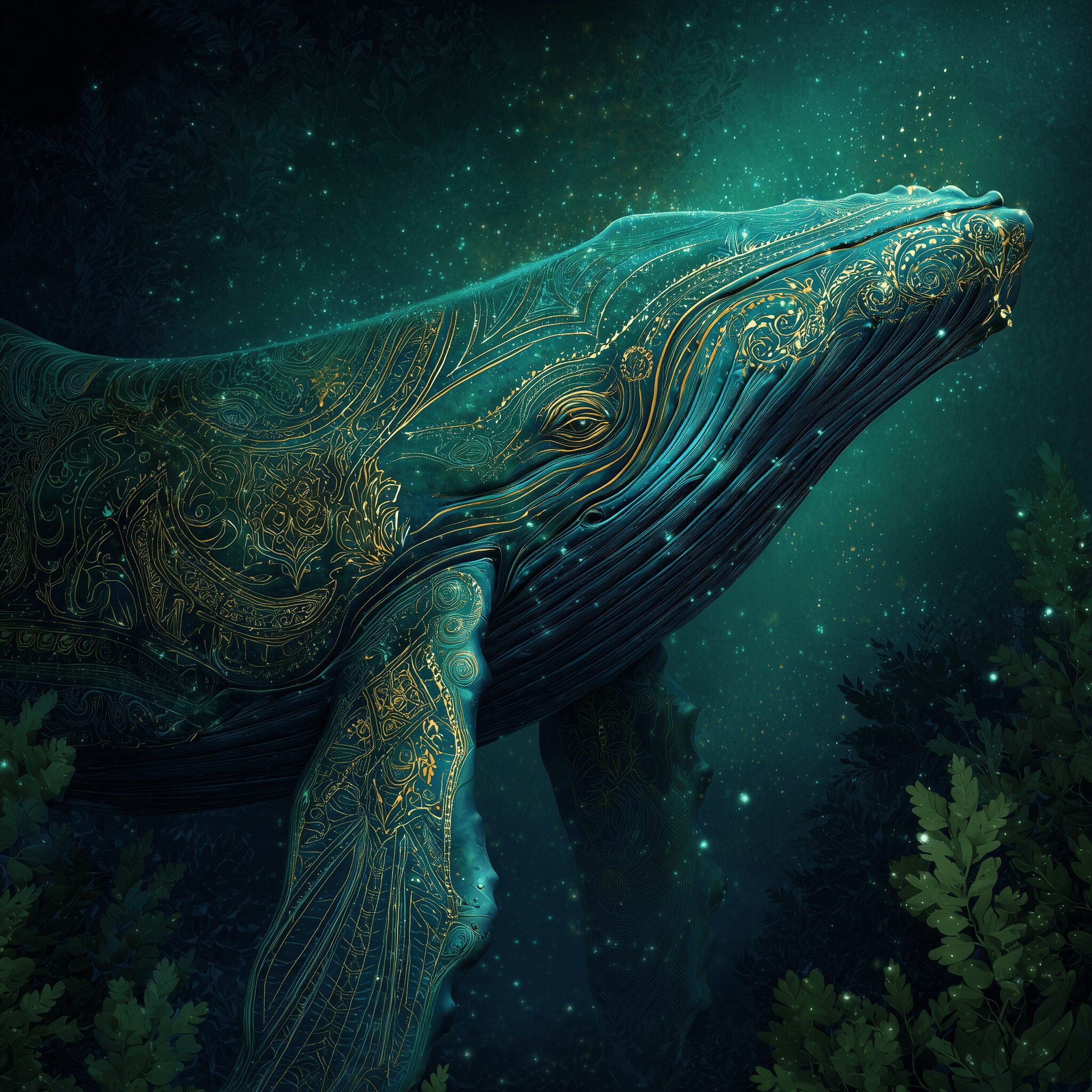

In 1967, a marine biologist named Roger Payne recorded the song of a humpback whale for the first time. The recording traveled around the world and triggered something no scientific paper had ever managed: millions of people wept upon hearing it. They didn’t know why. They didn’t understand what that sound was saying. But something inside them recognized it — as if an ancient, forgotten part of their being remembered a language it had never learned.
That is the whale’s effect. It doesn’t need you to understand it. It needs you to feel it.
The Memory of the Ocean
Whales have been on this planet for between 50 and 55 million years. They were land animals that chose to return to the sea — an evolutionary decision biologists still debate, but one that, viewed symbolically, is extraordinary: a creature that knew solid ground and decided to go back to the depths. To release the earth beneath its feet. To trust the water.
For the Māori of New Zealand, the whale is not simply a sacred animal: it is an ancestor. The legend of Paikea tells the story of a young man who, betrayed by his brother and thrown into the sea to die, was rescued by a humpback whale that carried him on its back to the shores of Aotearoa. The Ngāti Porou, one of the most important iwi (tribes) in New Zealand, trace their lineage directly to Paikea. The whale is not a symbol to them. It is family.
Along the coast of Vietnam, there is a tradition that surprises those who encounter it for the first time: the cult of Cá Ông, the Lord Fish — which is, in fact, the whale. Scattered along the Vietnamese coastline are temples dedicated exclusively to stranded whales. When a whale dies on the beach, the entire community participates in a funeral that can last three days, with incense, prayers, and ceremonial burial. Years later, the bones are exhumed and placed in the temple as sacred relics. For Vietnamese fishermen, the whale is a protector — the being that calms storms and guides vessels safely to port.
Among the Inuit of the Arctic, hunting the bowhead whale was — and still is — the most spiritually significant act of the year. But not in the way you might imagine. Before the hunt, the captain of the umiak (the communal boat) would fast, pray, and clean his home to receive the whale’s spirit. Because the Inuit do not believe they hunt the whale. They believe the whale gives itself. That it chooses whom to feed. And that if you are unworthy — if your heart is not clean, if your intention is not pure — the whale simply will not come.
The Tlingit and Haida of the Pacific Northwest carved whales into their totem poles and regarded them as guardians of clan memory. And in Aboriginal Australian tradition, the whale appears in Dreamtime stories as one of the beings who helped shape the coastline — its body forming the bays, its tail sculpting the cliffs.
The Song That Crosses Oceans
A male humpback whale can sing for 20 hours straight. Its song travels thousands of miles through the water. And most bewildering of all: whales within the same ocean sing the same song, which shifts gradually over the course of the year. When a change appears in one group, it spreads — like a trend, like a rumor, like an idea whose time has come — until every whale in that ocean basin adopts it.
Scientists don’t know exactly why they sing. It isn’t only for mating. It isn’t only for communication. There is something in that song that exceeds biological function, and that is what ancient peoples understood before science did: the whale does not sing to survive. It sings because singing itself is its way of existing.
Translated into the spiritual, the whale brings a message about voice. Not about speaking more or speaking better, but about finding your frequency — that unique register that belongs to you alone, and that, once found, resonates in others without you having to shout. People who need the whale’s medicine tend to have something important to say and don’t know how to say it. Or worse: they know, but they’re afraid that the sound of their truth is too large for the world around them.
The Shadow of the Whale: The Weight of Carrying Everything
The blue whale weighs 150 tons. It is the largest animal that has ever existed — larger than any dinosaur. And that immensity, which from the outside appears majestic, has a flip side that is rarely spoken of.
The whale’s shadow is weight. It is the person who carries everyone else’s emotions without anyone asking them to. Who absorbs others’ pain like an emotional sponge and then sinks beneath a burden that isn’t even theirs. The whale in shadow is the mother who forgets herself while caring for her family. The friend everyone calls when they’re struggling, but whom no one ever thinks to ask how they’re doing. The one who mistakes compassion for self-sacrifice.
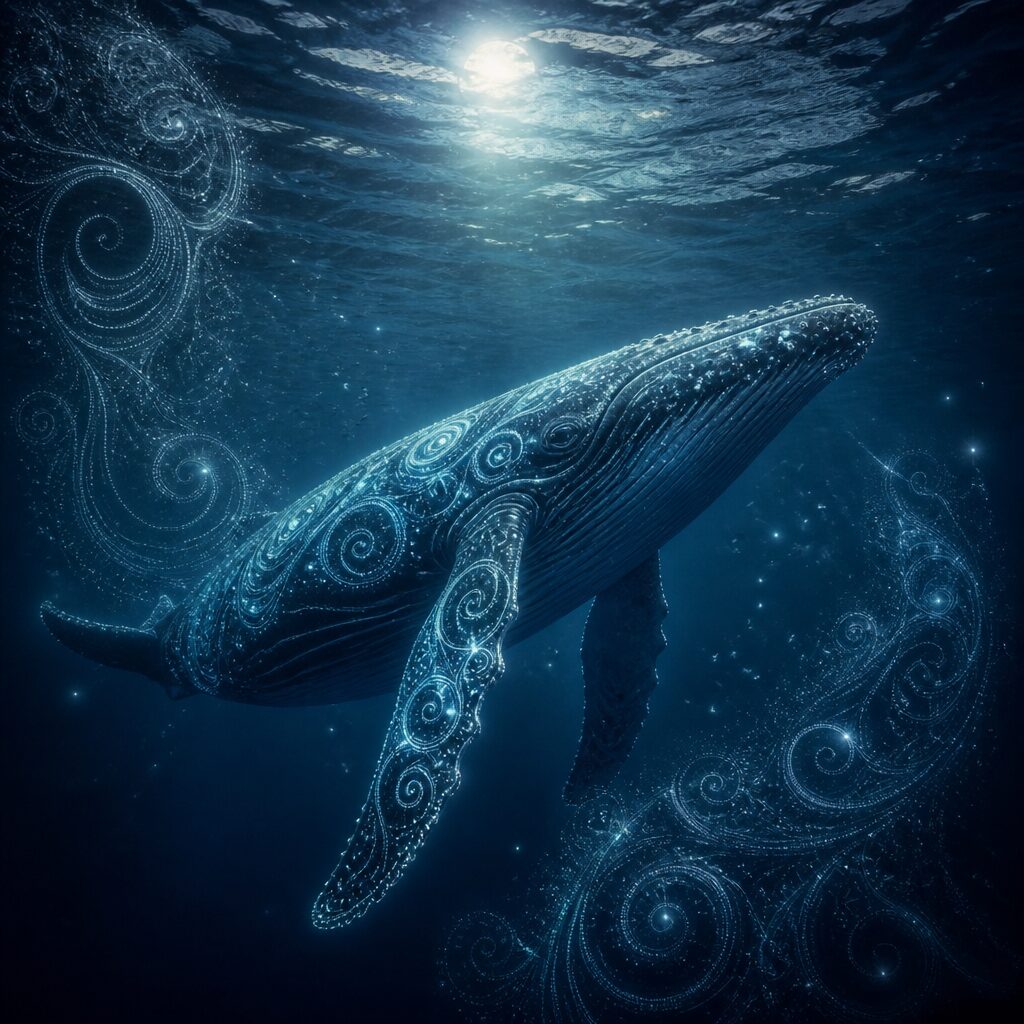
There is shadow in the silence, too. The whale sings, yes — but it can also submerge for hours without making a sound. The person caught in the whale’s shadow is the one who swallows what they feel, who dives into their own depths and never rises to the surface to breathe. Because that is something else to remember: the whale is a mammal. It breathes air. If it doesn’t surface, it drowns. And so do you.
The other face of this shadow is isolation dressed up as depth. “No one understands me” can be true — but it can also be the perfect excuse for never trying to be understood. The inverted whale points to the person who has convinced themselves that their emotions are too vast, too complex, too deep to share — and who uses that story to justify their loneliness.
The Whale as a Power Animal
Those who carry the whale as a power animal share a trait that isn’t always visible from the outside: they feel too much. Not too much in the sense of exaggeration, but in the sense that their emotional field is wider than most people’s. They pick up on what others miss. They sense tension in a room before anyone speaks. They absorb the moods of those around them without realizing they’re doing it.
They are people with a natural capacity for healing — not necessarily in a formal sense, but in the sense that others feel better after spending time with them. There is something in their presence that calms. That creates space. That allows suppressed emotions to surface without fear.
But that same sensitivity is their greatest vulnerability. The person with whale medicine needs to learn something that costs them deeply: to set limits. To say “this is not mine” when they feel another person’s pain. To rise to the surface to breathe before the pressure of the depths crushes them. The whale doesn’t survive by staying down indefinitely. It rises. It breathes. And it goes back down when it’s ready.
Those who walk with the whale also tend to have a particular relationship with memory. They remember everything — not just facts, but the emotions attached to those facts. A scent can transport them 20 years back with a vividness that startles them. A song can reopen a wound they thought had healed. That emotional memory is both their gift and their burden, and learning to navigate between the two is the work of a lifetime.
Working with the Whale’s Medicine
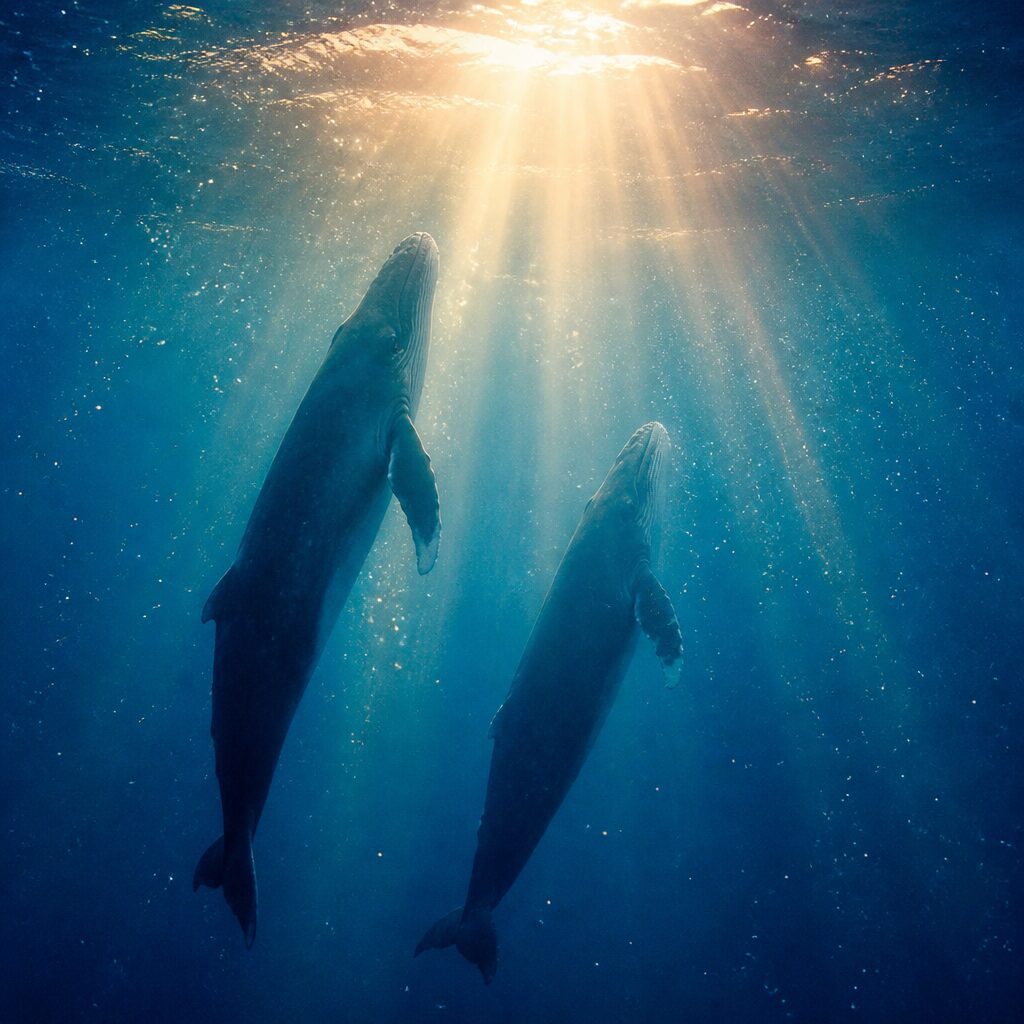
The most direct way to connect with the whale’s energy is through sound. You don’t need to go to the ocean — though if you can, do. Find a recording of the humpback whale’s song (several are available; Roger Payne’s 1967 recording remains one of the purest). Put on headphones. Close your eyes. And listen. Don’t analyze. Don’t interpret. Let the sound move through you the way water moves through everything it touches.
Another practice connected to the whale is conscious breathwork. Remember: the whale is a mammal that chose to live in water. Every time it rises to the surface, that breath of air is a deliberate act of survival. When you feel emotions pulling you under — when the weight is too much, when the depth is becoming dangerous — do what the whale does: surface. Breathe. Literally. Three deep, slow, intentional breaths. Not as a relaxation technique. As an act of emotional survival.
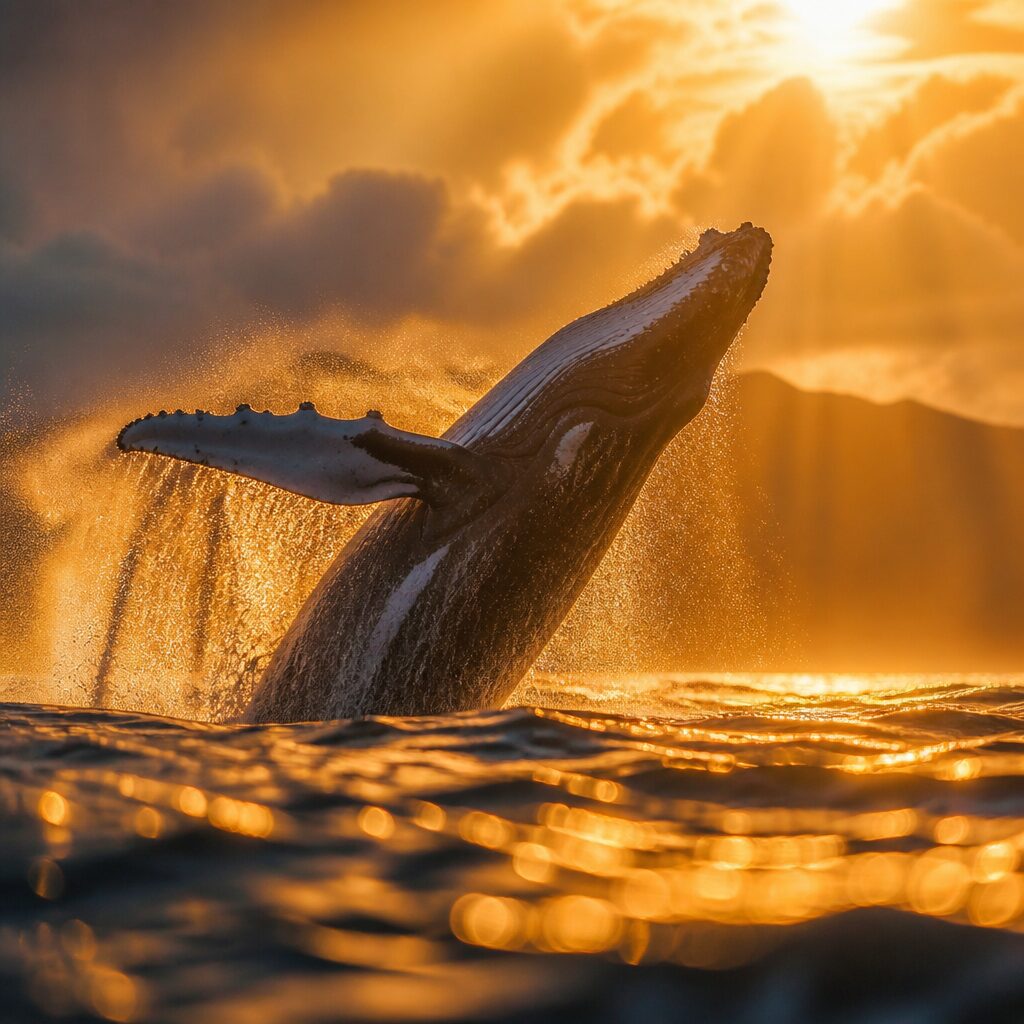
And if the whale appears in your dreams, pay attention to what it is doing. A whale swimming calmly suggests you are at peace with your emotional depths. A beached whale may signal that something large inside you needs urgent attention — an emotion, a process, a truth that has been left without water and is drying out from lack of expression. A whale breaching out of the water is one of the most powerful dreams there is: something enormous that you’ve been carrying inside is finally coming to the surface.
52 Hertz
There is a whale in the North Pacific that scientists have called “the loneliest whale in the world.” It sings at a frequency of 52 hertz — a pitch that no other whale species can hear. It has been tracked for more than 30 years. It swims alone. It sings alone. No one answers.
The story of the 52-hertz whale went viral because something in it feels unbearably familiar. We have all felt, at some point, that we speak at a frequency no one else can receive. That what we feel is too large, too strange, too deep to be understood.
But there is something in that story that almost no one mentions: the whale keeps singing. Thirty years swimming alone, and it keeps singing. It didn’t stop making its sound because no one answered. It didn’t change its frequency to fit in. It kept being exactly what it is, with the quiet confidence that its song has value even when no one hears it.
Perhaps that is the deepest thing the whale has to teach. Not that your voice will be heard. Not that the world will respond to your frequency. But that singing is the act itself. That authentic expression needs no audience to have meaning. And that sometimes, the bravest thing you can do is keep singing in a frequency that belongs only to you.