
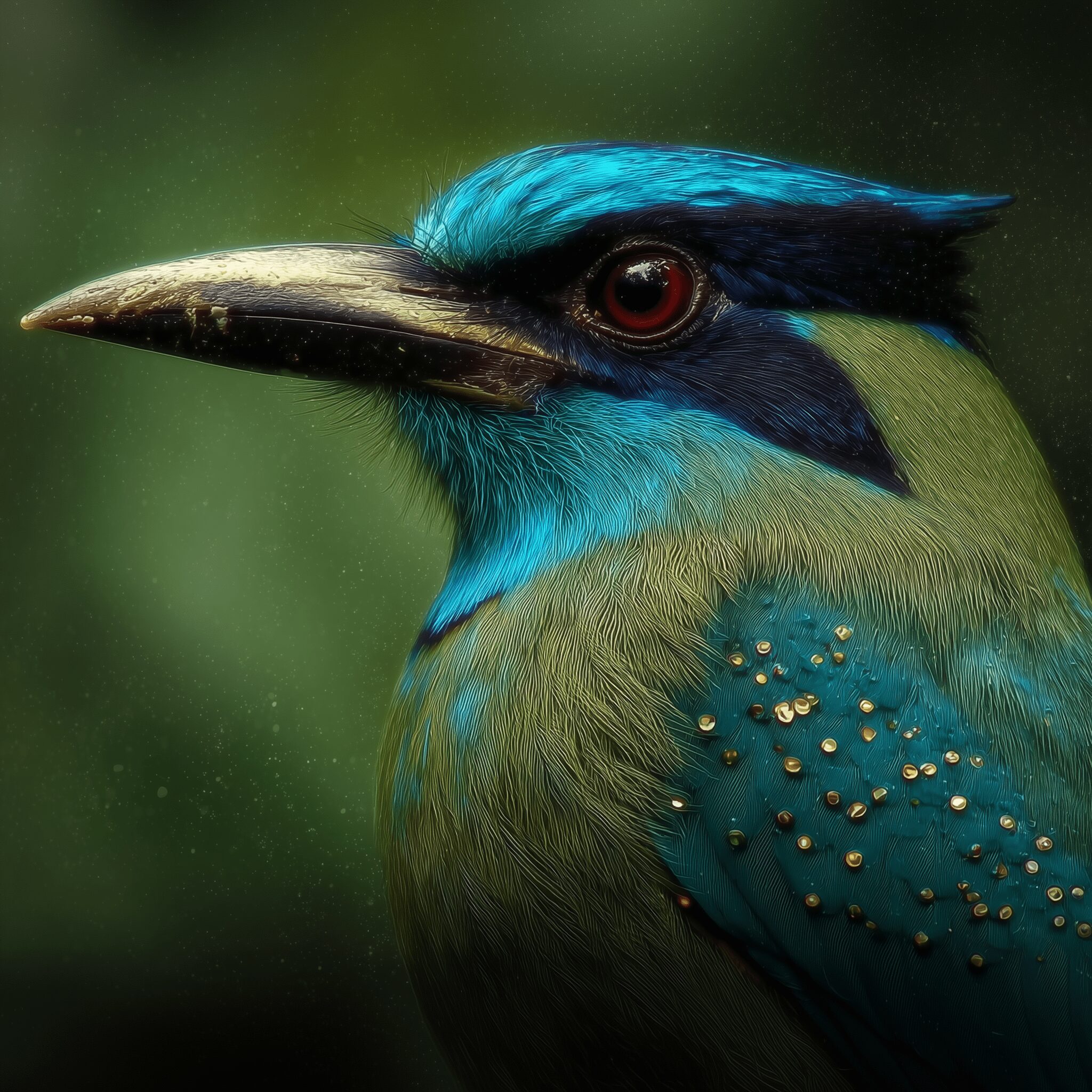

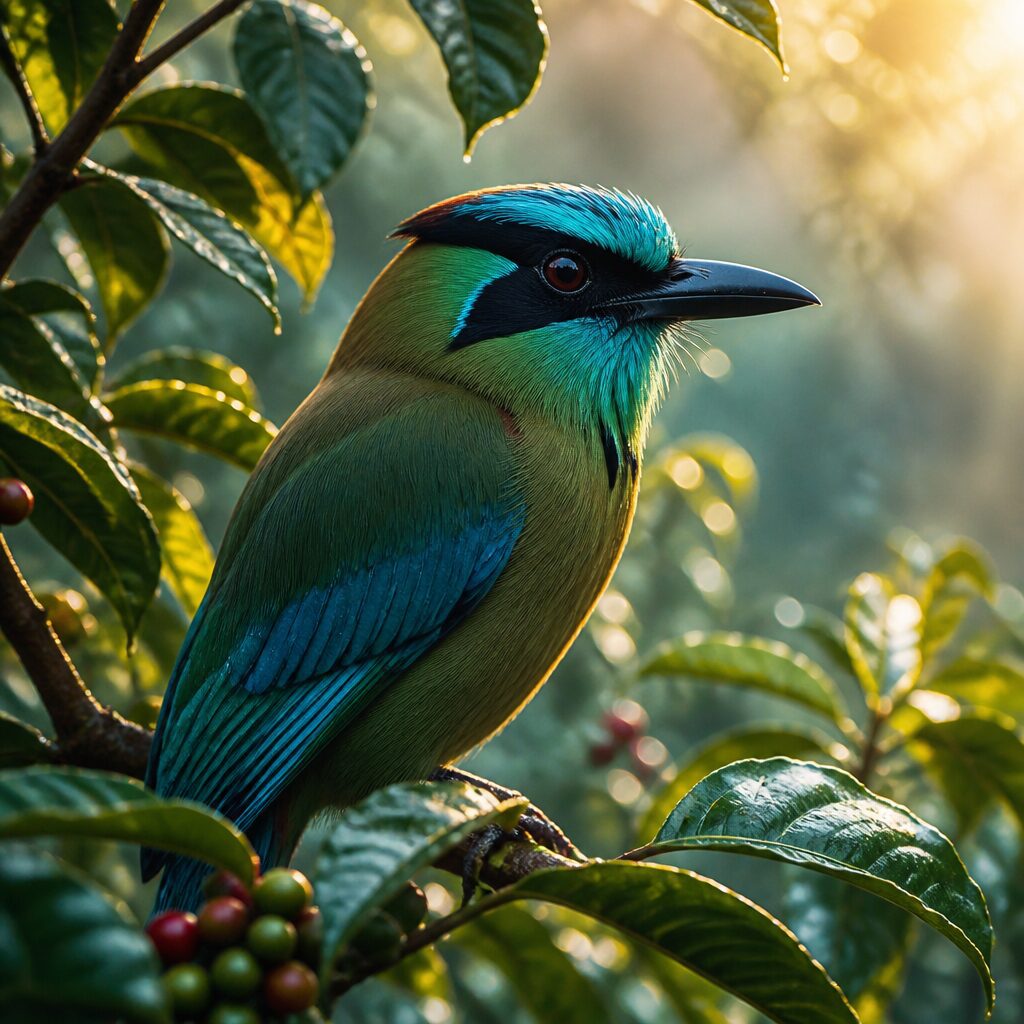
Five in the morning in a coffee plantation in Colombia’s Quindío region. The mist still weighs heavy between the trees. There is no noise — or rather, there is the kind of silence that has layers: crickets below, water somewhere far off, something you can’t identify above. Then you hear it. Jutu jutu. Two low notes, like someone blowing into a clay bottle. Jutu jutu. You search for the source of the sound and can’t find it. Until — there, on a low branch, so still it seems part of the tree — you see it.
A motmot. Turquoise and green, with a black mask cutting across its face like a carnival disguise. But what catches you isn’t the color. It’s the tail. Two long feathers ending in racket shapes, swinging like a metronome. Left, right. Left, right. A biological clock marking a time only this bird understands.
In Mexico they call it pájaro reloj — the clock bird — for exactly that reason. In Colombia, barranquero, because it nests in ravines. And in several regions, simply soledad. Solitude.
The Bird That Edits Itself
That pendulum tail doesn’t come factory-made. The motmot is born with full feathers, like any bird. But at some point, deliberately, it strips the barbs from the center of its two longest tail feathers, leaving only the tips intact. It edits itself. It sculpts itself. It is the only known bird that actively modifies its own appearance by removing parts of itself.
Biologists still debate why. Some suggest the racket-shaped tail serves as a visual signal to predators — a I already saw you, don’t waste your time. Others believe it’s sexual selection. But what no one disputes is the fact itself: this bird decides which parts of itself are excess and removes them. What remains is more beautiful, more functional, more fully itself.
The Maya had another explanation. According to a legend from the Yucatán Peninsula, when the gods created the world and asked the birds to help build nests for all species, the motmot refused. It sat on a branch and watched while the others worked. As punishment, the other birds tore the feathers from its tail while it slept. Since then, the motmot has carried its ragged tail as a mark of what happens when you choose stillness over action.
But here is where the legend becomes interesting: the motmot does not hide its broken tail. It swings it. It displays it. It turned its punishment into its most distinctive feature. No shame — only integration.

The Bird That Nests Where Others Won’t Go
The motmot doesn’t build a nest in the trees. It excavates. It digs a horizontal tunnel up to five feet deep into earthen walls, ravines, embankments — the edges of the world where the earth breaks and falls. Where most birds see danger, the motmot sees home.
That says a great deal about its medicine. The Muisca people of Colombia’s highlands associated the motmot with liminal spaces — those thresholds between one world and another. The ravine is precisely that: where solid ground ends and the void begins. The motmot doesn’t fear that edge. It settles there. It raises its young there. It lives at the exact point where the stable becomes unstable.
Farmers across Colombia’s coffee-growing region know this bird well. They see it perched on fence posts, on utility lines, motionless as if carved from wood. It can stay like that for twenty minutes, thirty, an hour. And then — a movement so fast you almost miss it — it launches, catches an insect mid-air, and returns to the same branch. The same stillness. As if nothing happened.
What the Motmot Has Come to Tell You
If this bird has appeared in your life — in a dream, in an unexpected encounter, in an image you can’t shake — it didn’t come with an urgent message. The motmot doesn’t do urgency. It came to ask you something more subtle: when was the last time you were truly still?
Not still the way you are when you’re scrolling your phone on the couch. Still the way the motmot is on its branch: every sense alive, waiting for the exact moment to act. There is a vast difference between inactivity and active stillness. The first is evasion. The second is contained power.
The motmot speaks to you about economy of movement. This bird doesn’t chase its food — it waits for it to pass. It doesn’t burn energy hunting on the wing like a hummingbird, or pecking at the ground like a chicken. It sits. It watches. And when the right prey crosses its field of vision, it acts with a precision that leaves no margin for error.
How much of your energy goes into movements you don’t need to make? How many unnecessary conversations, how many reactive decisions, how much noise do you add to your life because stillness makes you uncomfortable? The motmot isn’t asking you to stop moving. It’s asking you to stop moving out of habit.
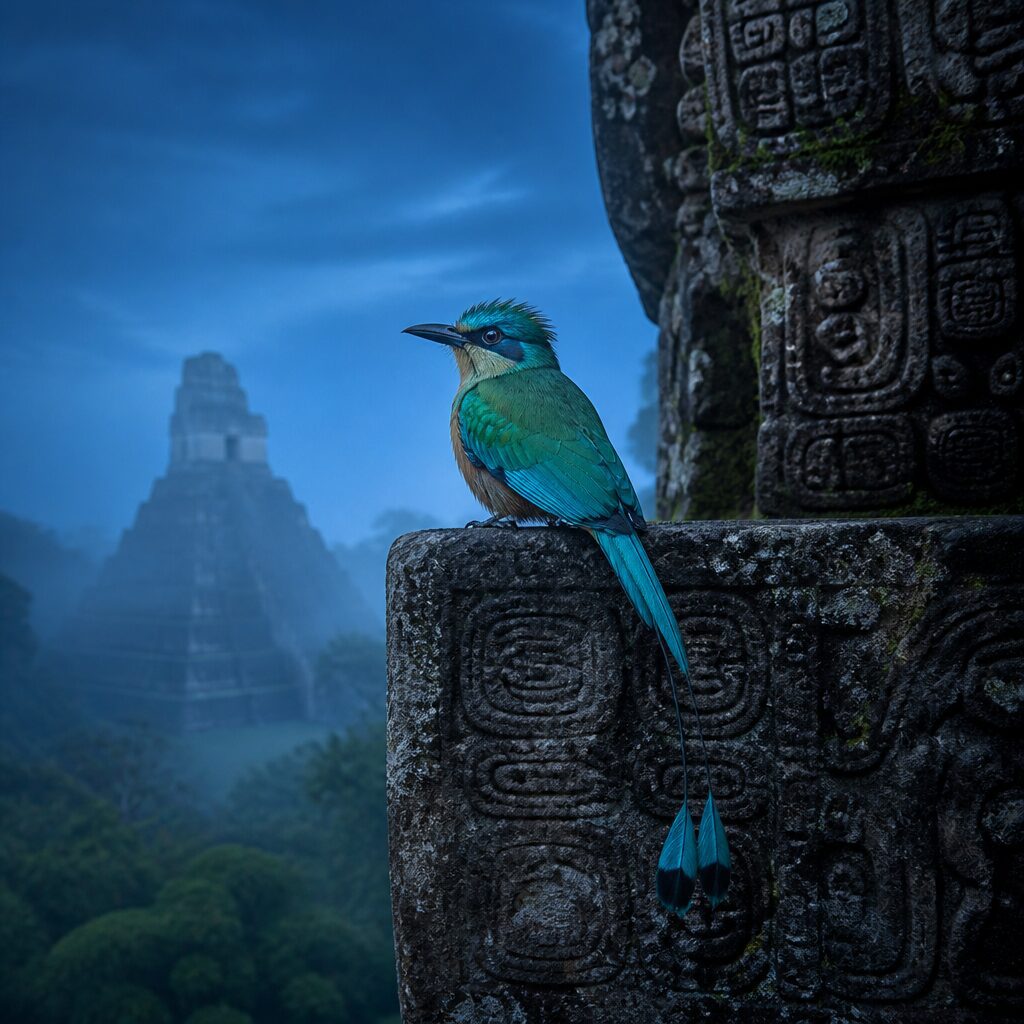
And there is something else: the motmot nests at the margins. Not at the heart of the forest, not in the highest canopy, not where everyone is looking. At the edge. In the crack. In the ravine. If you feel that your place is at the margins — that your work, your perspective, your way of living doesn’t fit the center of what’s established — the motmot is telling you that is not a defect. It is your natural habitat. Some of us are made for edges, and from there we see things those at the center will never see.
The Shadow of the Motmot
The motmot’s stillness is beautiful when it’s genuine. But it has a reverse side that must be faced.
Contemplation as evasion. “I’m observing, processing, integrating.” Sometimes that’s true. And sometimes it’s the most elegant excuse in the world for doing nothing. The motmot’s shadow sits on its branch and calls “discernment” what is actually fear. Fear of acting badly. Fear of making a mistake. Fear that movement will shatter the image of calm it has so carefully constructed. If you’ve spent months “reflecting” on a decision you already made deep down a long time ago, the shadow motmot has you paralyzed.
The ravine as fortress. The motmot nests where no one easily reaches. That is wisdom — until it becomes a strategy for isolation. The shadow of this bird builds its life in places so inaccessible that no one can find it. Not because it seeks peace, but because it doesn’t want to be reached. If your “sacred space” has become an excuse for no one to confront you, question you, or hold you accountable, you’re nesting in a ravine for the wrong reasons.
Waiting for what never comes. The motmot waits for the right prey. Admirable. But its shadow waits forever. The perfect moment. The unmistakable sign. The absolute certainty that this is the moment. Meanwhile, opportunities pass. Prey crosses the field of vision and the shadow lets them go because “it wasn’t the right one yet.” Sometimes the right prey was the one you let pass three months ago.
Calm as a mask. The motmot appears serene. Unruffled. But beneath that stillness there is an alert nervous system, muscles ready to fire, eyes registering every movement. The shadow of this bird is the person who projects calm while boiling inside. Who has learned so well not to react that they no longer know what they feel. Who confuses emotional control with emotional anesthesia.
Walking with the Motmot
The motmot’s medicine is not practiced by doing more. It is practiced by editing.
The first exercise is literal: sit somewhere you can observe nature — a park, a garden, a balcony with a view of trees. Do nothing. Don’t identify species, don’t take photos, don’t think about what you see. Just look. Let your eyes rest wherever they want. The motmot doesn’t seek its prey — it lets it come. Practice that for twenty minutes. You’ll discover how hard it is to do nothing when your mind has forgotten how to stop.
The second exercise is more uncomfortable: choose one thing in your life you no longer need and remove it. Not “put it on pause” — remove it. A social obligation that drains your energy. A subscription you don’t use but keep “just in case.” A conversation you’ve been dragging along unresolved. The motmot strips its own feathers to become what it truly is. What do you need to strip away?
And the third: the next time someone asks you for an immediate response, say “let me think about it.” Not as a tactic — as a practice. The motmot doesn’t respond to the first stimulus. It lets the pendulum swing. Left, right. Only when the inner rhythm marks the moment does it act. You can afford yourself that luxury too. Most things that seem urgent are not.
The Pendulum That Measures Another Time
In Colombia’s coffee region there is a folk belief: when you see a motmot and its pendulum tail goes still, something is about to change. Not something bad necessarily — something. As if the bird’s clock marks a break in the routine of the universe.
It is probably superstition. But it carries the truth of things that people observe across generations. The motmot marks a time that is not ours. Not clock time, not notification time, not productivity time. An older time. The time of the ravine eroding grain by grain. The time of the tunnel dug centimeter by centimeter. The time of the feather stripped away when it is no longer needed.
If you are reading this with the feeling that your life is moving too fast and you don’t know how to slow it down, the motmot has just landed on your branch. It made no noise. It asked for no attention. It is simply there, swinging its tail, measuring a time that almost no one listens to anymore.
Jutu jutu.