
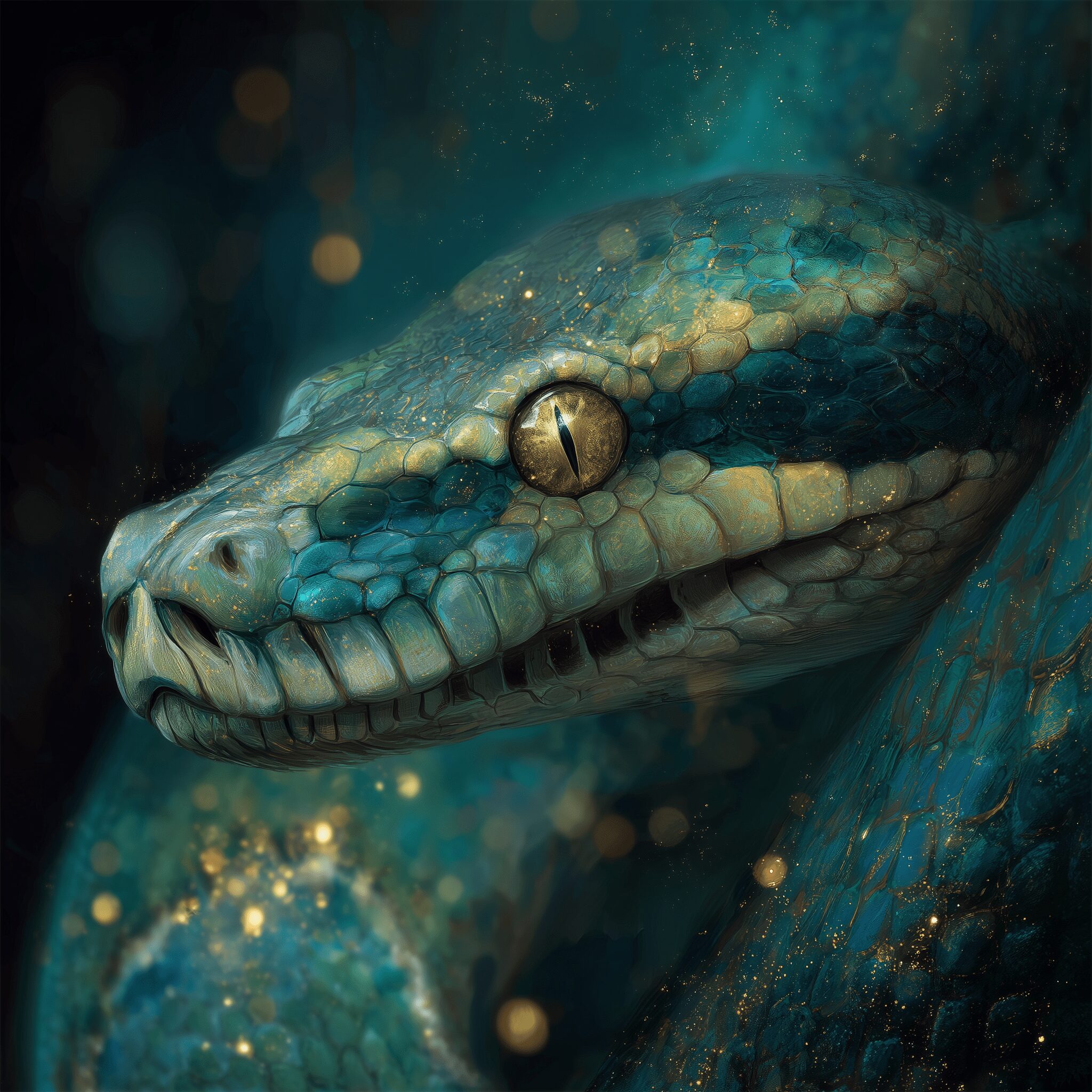

An engineering problem: design a predator with no legs, no venom, no claws, no speed, capable of killing and swallowing a six-foot caiman. Constraints: it cannot chew (the jaw doesn’t have that range of motion). It cannot tear (no limbs). It cannot poison (no venom glands). Solution: constriction. Ninety kilos of pure muscle wrapping around prey in coils that tighten with every exhale. It doesn’t break bones — it prevents the lungs from filling. Each breath is shorter than the last. Each exhale is the final chance. The pressure doesn’t kill by crushing. It kills by asphyxiation. The heart stops. And then the anaconda opens its mouth — one hundred and fifty degrees, jaws connected by elastic ligaments, not fused like yours — and swallows the caiman whole. Head first. Digestion will take weeks.
There is nothing elegant about the anaconda. Nothing subtle. It is brute force, absolute patience, and the capacity to literally swallow something larger than your own head. If this animal is calling to you, it’s probably because you’re standing in front of something that seems impossible to digest.
Yacumama, the Mother of Water
For Amazonian peoples — the Shipibo-Conibo, Asháninka, Kukama, among dozens of others — the anaconda is not an animal. It is the Yacumama. The Mother of Water. A primordial being that inhabits the deepest rivers and is responsible for the very shape of the landscape. The river’s curves, its meanders, its oxbow lakes — these are the trace left by the Yacumama’s body moving beneath the earth. The river doesn’t flow where it wants. It flows where the anaconda carries it.
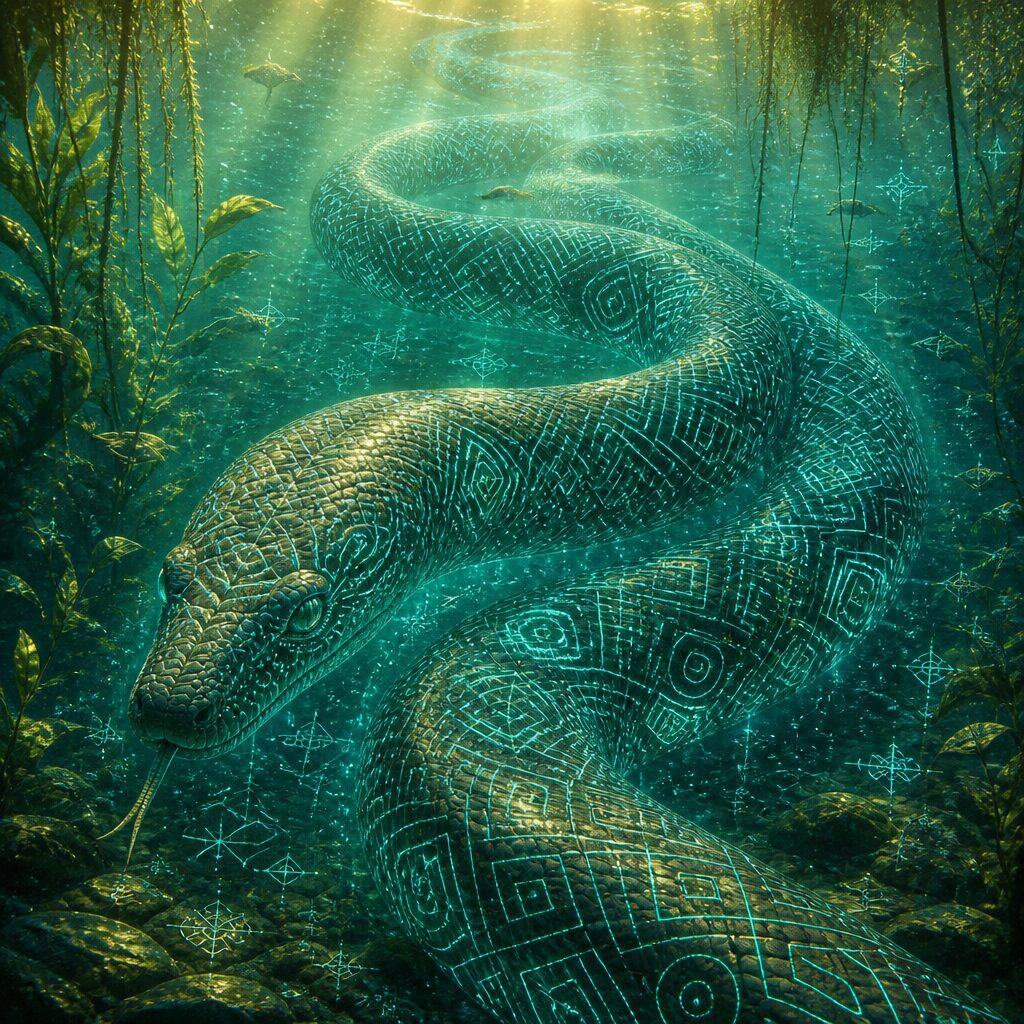
In Shipibo cosmology, the cosmic anaconda — Ronin — is the being that connects the upper world with the lower world through water. Shipibo shamans, during ayahuasca ceremonies, report recurring visions of giant anacondas coiling and uncoiling, forming geometric patterns — the same patterns that Shipibo women embroider into their textiles, the kené. Those designs are not decorative. They are maps of the universe as the anaconda reveals it during trance. The world’s largest snake is, for the Shipibo, the librarian of the cosmos.
The Kukama-Kukamiria of Peruvian Amazonia tell that the Yacumama can transform into a boat, a beautiful woman, a floating log. She comes out at night. She lures the unwary. She pulls them to the bottom. Not out of malice — because the river demands tribute. Because life and death in the Amazon are not opposites but are coiled inside each other, like the anaconda’s own spirals. The river that feeds you is the same river that drowns you. The anaconda that kills you is the same anaconda that shaped the channel you navigate. You cannot have one without the other.
In the Desana mythology of the Colombian Vaupés, the ancestral anaconda — the Canoe-Anaconda — transported the first human beings upriver from the east, from the “Lake of Milk” at the origin of the world, to the territories where each clan settled. The anaconda did not create humans. It transported them. It carried them, inside its body, as it carries its food. And it deposited them, one by one, at the places along the river that belonged to them. The founding of each Desana village is, literally, a point where the anaconda opened its mouth and let a group of people out.
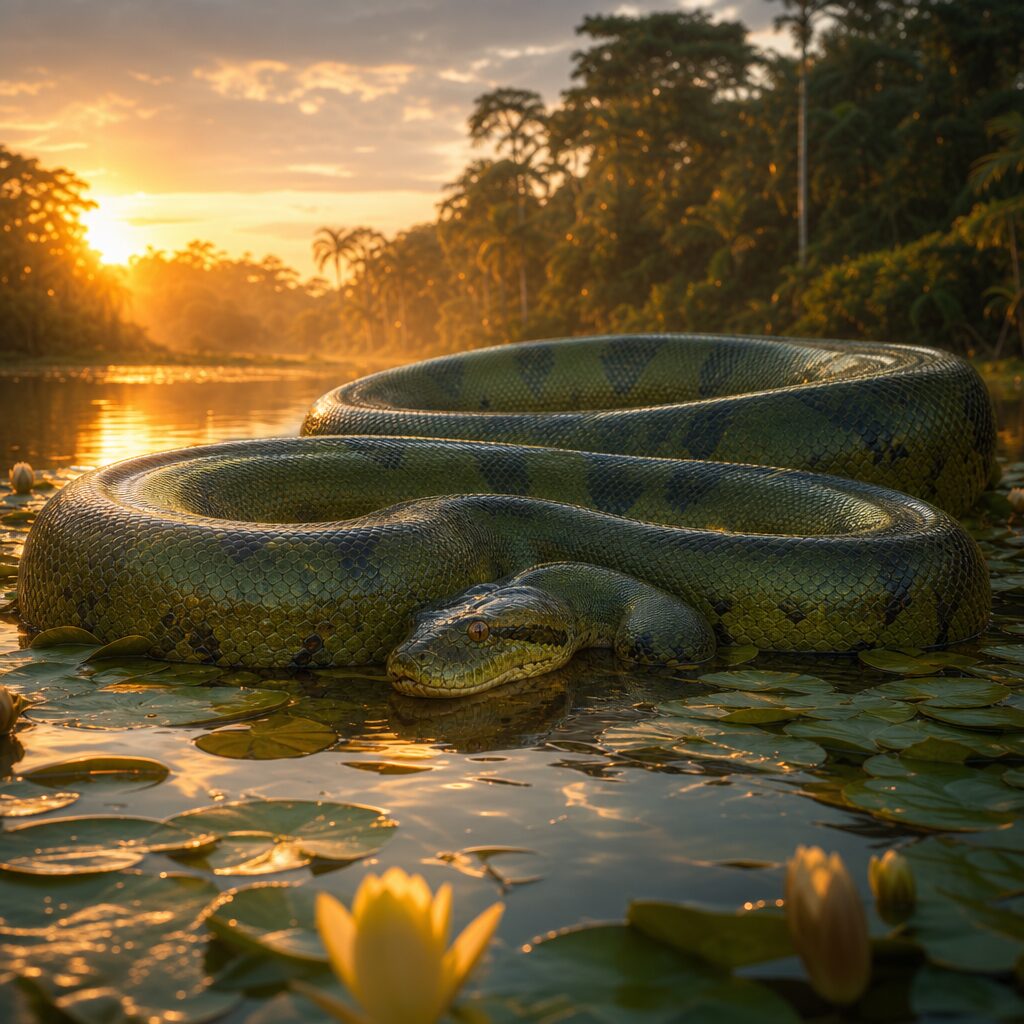
In the Amazonian Kichwa tradition of Ecuador, the anaconda — amarun — is the guardian of the supay, the underwater spiritual world. The yachak (shamans) who wish to access the deepest knowledge must confront the anaconda in visions. Not fight it — that would be spiritual suicide. Let themselves be enveloped. Accept the constriction. Survive the pressure. And emerge transformed. The anaconda doesn’t kill you in shamanic vision. It squeezes until everything false in you breaks. And what survives that pressure is what you truly are.
Ninety Kilos of Muscle, Zero Kilos of Hurry
The green anaconda — Eunectes murinus — is the heaviest snake in the world. The largest documented specimens reach two hundred and fifty kilos and over twenty-three feet in length, though historical accounts speak of specimens of thirty feet or more that modern science has not been able to confirm. It is not the longest — that is the reticulated python — but it is the most massive. A cylinder of muscle the diameter of a tree trunk, covered in olive-green scales with black spots that work as perfect camouflage in the murky waters of the Amazon.
The anaconda is an ambush predator. It doesn’t chase. It waits. It can spend days submerged with only its eyes and nostrils above water, motionless, blending in with a log or a mudbank, until something — a capybara, a peccary, a caiman, a deer — comes close enough to the water. Then it acts. And when it acts, there is no second chance for the prey. The coils close in fractions of a second. The pressure increases with each exhale of the victim. No animal force can open the coils of an adult anaconda from the inside.
After a large meal — a hundred-pound capybara, for example — the anaconda can go weeks or months without eating. Its metabolism slows to near-hibernation levels. It digests slowly, completely, wasting nothing. Bones, horns, hair — everything dissolves in gastric acids powerful enough to dissolve metal. The anaconda discards nothing it consumes. It integrates everything.
And one detail that connects directly to shamanic tradition: the anaconda sheds its skin whole. Not in pieces, like other reptiles. One complete piece, from head to tail, left floating on the water like a translucent ghost of the snake it once was. In an ecosystem where everything rots within hours from tropical humidity and heat, finding an intact anaconda skin floating on a river must have been, for the original Amazonian peoples, like finding a message from the underworld.
Who Walks with the Anaconda
People with anaconda medicine are not subtle. Not fast. Not light. They are deep. They carry a presence felt before they enter the room — an emotional density, a gravity that draws people in and sometimes frightens them. Like the anaconda in murky water, you don’t always see them coming. But when they arrive, their presence is undeniable.
They are people of constriction — in the best sense. When they commit to something — a project, a relationship, a cause — they wrap around it with an intensity that leaves no room for half-measures. They don’t do things halfway. They don’t ease up. They don’t release until the process is complete. That can be overwhelming for others. For the anaconda person, it’s simply how it works: all or nothing.
They have an extraordinary capacity for metaphorical digestion. They can process experiences that would destroy others — trauma, loss, betrayal, catastrophe — and not just survive but integrate them. Not quickly. Slowly. Weeks, months, sometimes years of silent processing where everything dissolves, gets absorbed, becomes part of you. The anaconda person doesn’t “get over” things. They digest them. And when the process is complete, nothing remains of what the problem was. Only nutrients.
The Shadow of the Anaconda: When Holding Becomes Suffocating
The anaconda kills by constriction. Every exhale of the prey allows it to squeeze a little tighter. It gives no space. It does not ease up. And that is its exact shadow as a power animal.
The person in the anaconda’s shadow suffocates. They suffocate relationships with an intensity that gives the other no room to breathe. They suffocate projects with a control so absolute that nothing can move. They suffocate their children, their partner, their team with a presence so dense that the other person feels each exhale is shorter than the last. And they do it with love. That is the darkest part of this shadow: the anaconda doesn’t hate its prey. It simply holds it until it stops breathing.
The second shadow is emotional ambush. The anaconda that waits, motionless, invisible, until prey comes close enough. The person who stores resentments, accumulates grievances, gathers evidence in silence — and when they finally act, the constriction is so sudden and so total that the other person doesn’t understand what happened. “Everything was fine,” says the prey. No. You were being watched. Every mistake was registered. And the anaconda waited for the perfect moment to close.
The third shadow: swallowing what you cannot digest. The anaconda can eat an entire caiman. But sometimes the caiman is too large. There are documented cases of anacondas found dead with prey half-swallowed, their bodies burst by the ambition to consume something beyond their capacity. The person in this shadow takes on more than they can process. More work, more responsibility, more pain, more commitment. They swallow everything whole, head first, without assessing whether their system can digest it. And sometimes they burst.
The shadow question of the anaconda: does your embrace nourish or suffocate? Is your patience strategy, or an accumulation of poison? Is what you swallowed feeding you, or killing you from the inside?
How to Work with Anaconda Medicine
Learn to release. The anaconda releases its prey once it stops breathing. It doesn’t keep squeezing just in case. It doesn’t constrict after death. The moment of release is precise — neither before nor after. If you carry anaconda medicine, your greatest temptation is to keep squeezing when the process has already finished. To keep controlling when the project has already been delivered. To keep processing when the experience has already been digested. Practice releasing at the exact moment. Not one minute more.
Use water. The anaconda lives in water. It moves best in water. It hunts in water. If you are working with this medicine, water is your activation element. Rivers, lakes, rain, even the shower. Water dissolves rigidity, loosens unnecessary constriction, and reminds you that the river’s power comes not from hardness but from constant flow. If you feel you are holding too tight — a relationship, a problem, a version of yourself that no longer serves — get into water. Literally or figuratively. Let the current loosen what your coils won’t release.
And respect your digestion time. The anaconda doesn’t eat twice in one week. It eats once and digests for weeks. If you have just passed through something large — a loss, a change, a transformation — don’t throw yourself immediately into the next thing. Don’t swallow another prey before you’ve digested the first. Give your system the time it needs to dissolve, absorb, integrate. Hurry is for predators who hunt every day. You are not that kind of predator. You are the one who eats once and lives off it for months.
The River Shaped Like a Serpent
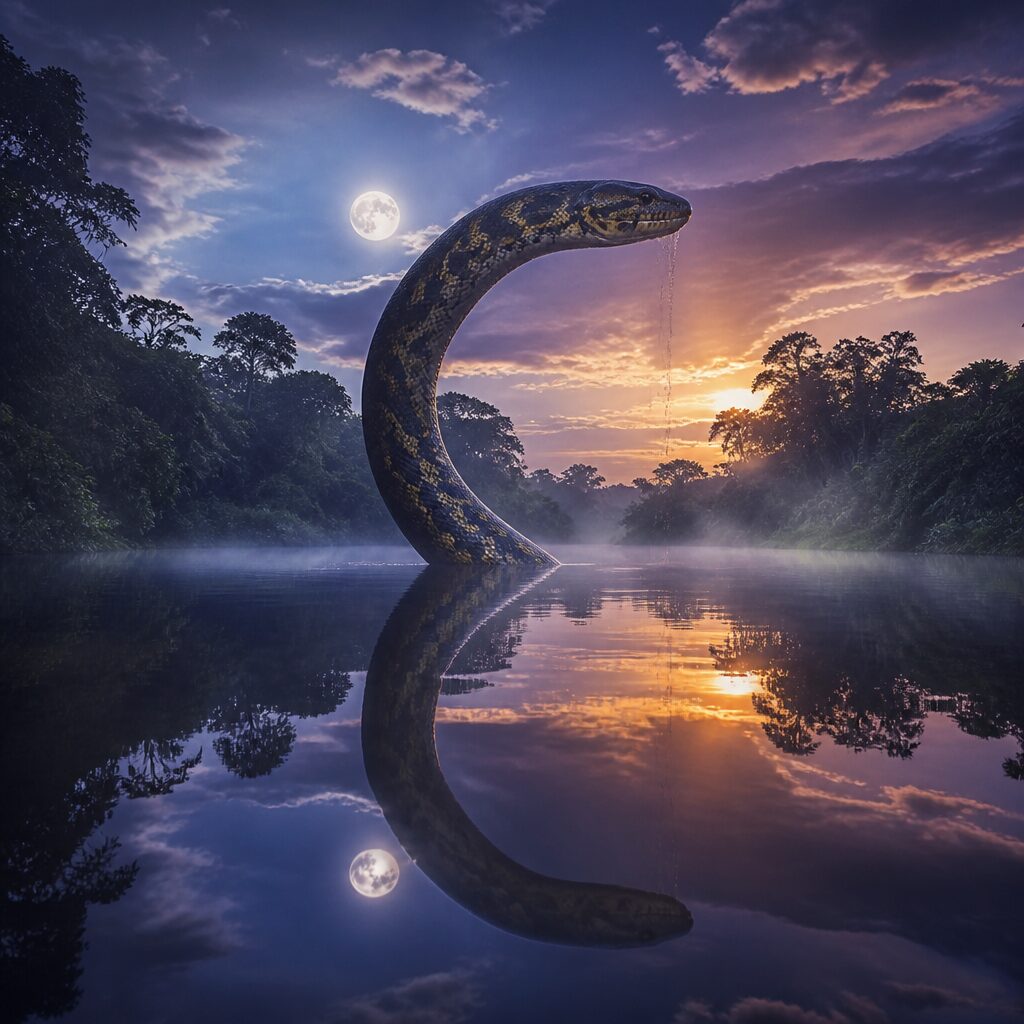
Seen from a satellite, the Amazon basin looks like a circulatory system. Arteries, veins, capillaries of brown water branching in every direction through two and a half million square miles of forest. And if you look at the meanders — those wide, sinuous curves the river traces — they look exactly like what the Shipibo always said they were: the trail of a giant serpent moving beneath the earth.
Geologists have their explanation: differential erosion, current velocity, sediment deposition. The Shipibo have theirs: Ronin moved, and the water followed. Both explanations produce the same landscape. But only one tells you something about yourself.
If the anaconda is calling to you, it is not asking you to be stronger. You are already strong — probably more than you know. It is asking you to use that strength with precision. To embrace without suffocating. To swallow what needs to be swallowed without bursting. To wait without losing attention. And when you release — because everything is released eventually — to leave a new channel where the river can flow. Not because you forced it. Because your body, in moving, gave shape to the water.