
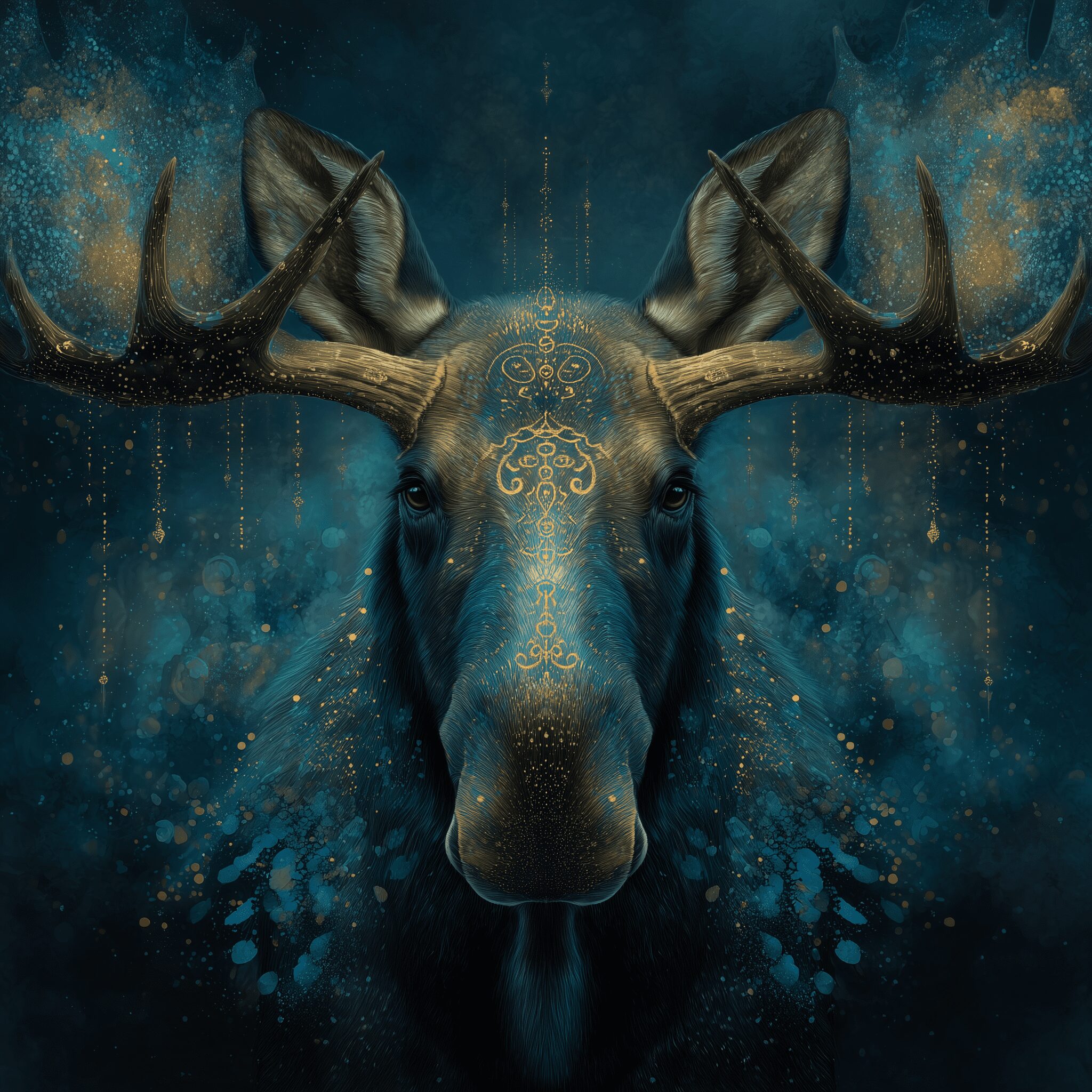

Look at it carefully. Legs too long for its body. An enormous head crowned by antlers that look like an evolutionary afterthought. A bulbous upper lip that hangs as if nature forgot to finish the job. The American moose is, objectively, one of the most absurd-looking animals in the boreal forest. And also one of the most dangerous. More people are hospitalized each year from moose encounters than from bears and wolves combined. A mature bull weighs over 1,500 pounds, runs at 35 miles per hour, and can kick in any direction with a force that snaps ribs like dry branches.
That is the moose’s first lesson: never mistake appearance for power. What looks clumsy can be lethal. What looks slow can be unstoppable. What looks ridiculous can be sacred.
The silent giant of the northern peoples
For the Anishinaabe (Ojibwe), the moose — Mooz — is one of the most important clan animals. The Moose Clan belongs to the builder and protector group: those whose responsibility is ensuring the community has what it needs to survive. Not the warriors, not the visionaries — the ones who make sure there is food, shelter, and stability. The invisible work that holds everything visible in place.
The word “moose” itself comes from the Algonquin moos, meaning “he who strips bark.” It is a name that speaks of nourishment, of sustenance, of the capacity to draw nutrition from what others dismiss as worthless. The moose eats bark, branches, aquatic plants, roots — everything other animals pass over. It finds food where others see scarcity. Translated into spiritual terms, that is extraordinary medicine.
For the Innu of Labrador, the moose — Moush — was the most sacred prey. Before each hunt, a hunter would spend days in spiritual preparation: fasting, singing, dreaming. The Innu did not believe the hunter caught the moose. They believed the moose offered itself — but only if the hunter was worthy. If respect was absent, the Moush simply would not appear. You could track for weeks and find nothing. The hunt was a test of character, not of skill.
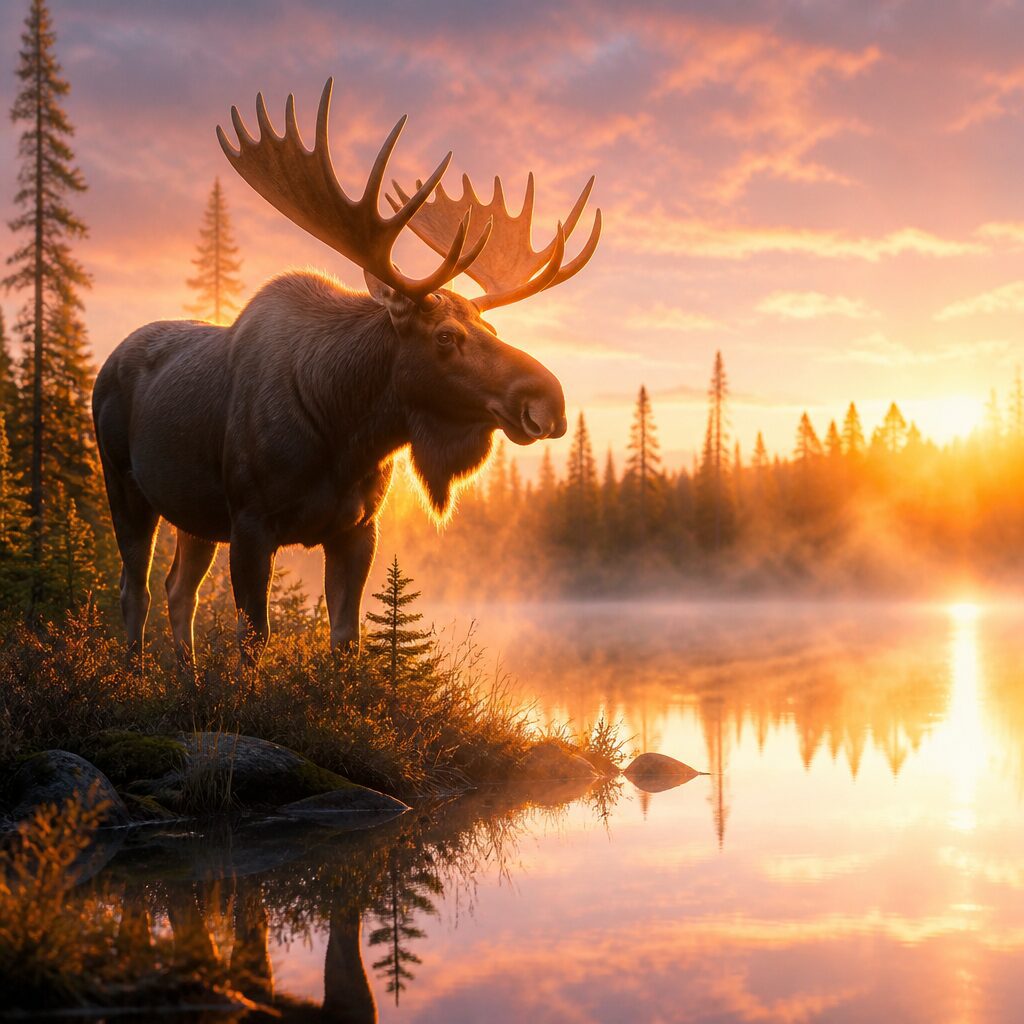
In the Norse tradition, the elk was linked to the goddess Freyja and to the World Tree, Yggdrasil. Vikings carved amulets from elk antler as protection, and in Norse mythology, four great deer — figures some scholars identify with the European elk — gnawed at the branches of Yggdrasil, feeding from the tree that held all worlds together. The moose, again, extracting sustenance from what upholds reality itself.
The antlers: releasing what once defined you
Every winter, the bull moose sheds his antlers. All of them. Those 40 pounds of bone and velvet that for months were his identity, his combat tool, his way of saying this is who I am — they fall to the forest floor and decompose. And every spring, a new set grows. Larger. Stronger. Different from the one before.
Few spiritual metaphors are this direct. What defined you yesterday does not have to define you tomorrow. The identity you built — the title, the role, the way others see you — can be released when it has served its cycle. And what grows in its place will be greater, as long as you do not cling to what already fell.
People collect old antlers in the woods and hang them on their walls. There is nothing wrong with that. But the moose does not do this. The moose drops what no longer serves it and keeps walking. It does not look back. It does not mourn what was lost. It trusts that the new will come, because it always has.
The shadow of the moose: stubbornness dressed as strength
A bull moose during rutting season is one of the most unpredictable animals on earth. He becomes aggressive, territorial, irrational. He charges cars. He rams trains. He fights other bulls until both are so exhausted that sometimes neither survives. The same force that makes him formidable becomes, at his worst, blind destruction.
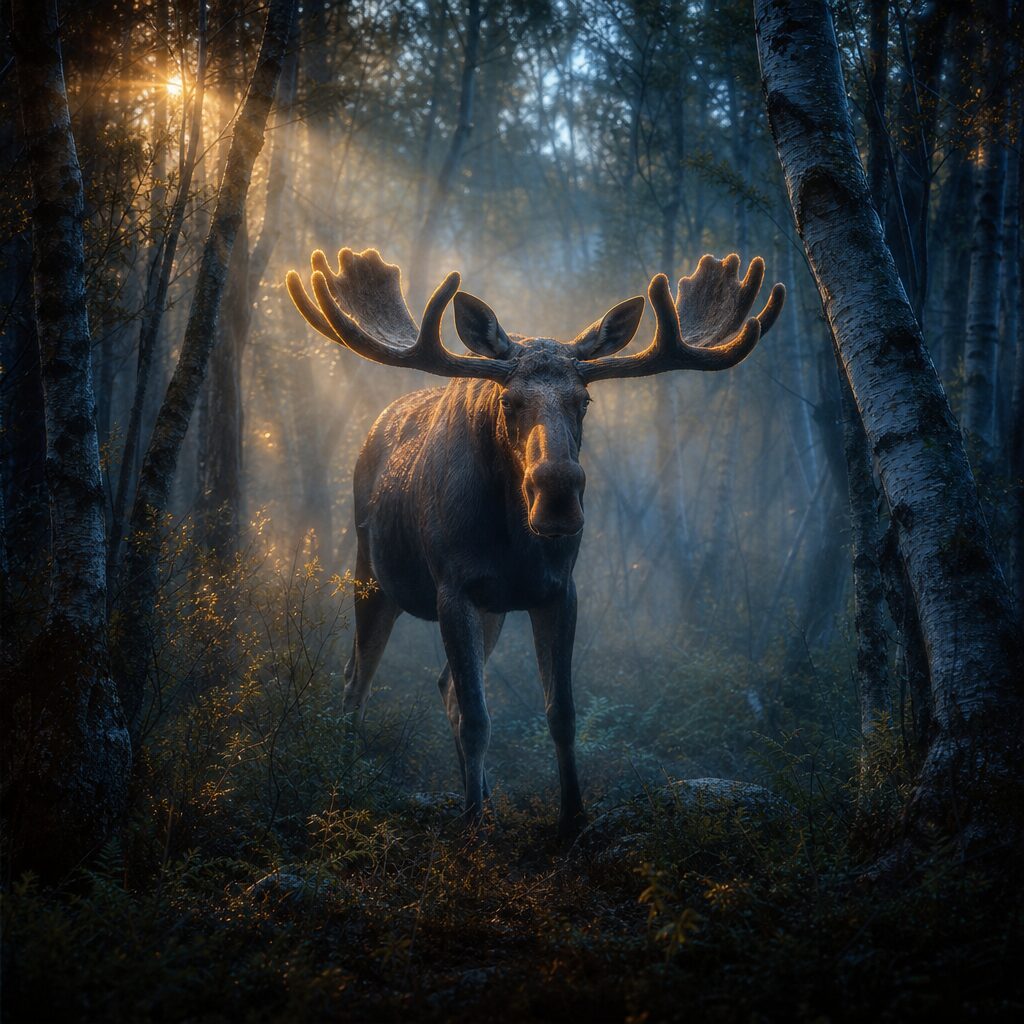
The shadow of the moose is stubbornness. Not firmness — stubbornness disguised as firmness. It is insisting on a path that clearly is not working because surrendering feels like weakness. It is confusing persistence with obstinacy. It is refusing to ask for help when you need it because your size — physical, emotional, or symbolic — has convinced you that you should be able to handle everything alone.
There is also the shadow of isolation. The moose is largely solitary, unlike deer that travel in herds. That solitude can be strength — but it can also be the perfect excuse for never building real bonds. The person caught in the moose’s shadow tells themselves they need no one. That they are self-sufficient. That they are fine alone. And sometimes that is true. But sometimes it is a wall built with pride and held in place by fear.
And there is a subtler shadow: unintentional intimidation. The moose does not try to frighten anyone. It is simply large. But its size causes others to step back, to shrink, to withhold what they actually think. Someone carrying unbalanced moose medicine can dominate a room without realizing it — their presence dims everyone else’s, and nobody says a word because, well, who tells a moose it is taking up too much space?
The moose as a power animal
People who carry moose medicine have a presence that needs no announcement. They walk into a room and something shifts — not because of what they say or do, but because of how they occupy space. They are people of few words and many actions. They do not seek attention, yet they draw it. They do not seek leadership, yet others follow naturally.
Those who walk with the moose tend to have a particular relationship with endurance. Not the spectacular endurance of the sprinter, but the endurance of the long-distance runner — the capacity to hold a sustained pace over extended periods without collapsing. They are the ones who finish what they start. The ones who keep going when others quit. The ones who need no external motivation because they run on an internal engine powered by consistency, not inspiration.
They also tend to carry a deep connection to self-worth — not the self-worth of someone seeking validation, but of someone who simply knows their own value. That quiet confidence that needs no proof, because it has already proven itself a thousand times in private. The moose does not compete with anyone. It does not need to. It already knows it is the largest animal in the forest.
Working with moose medicine
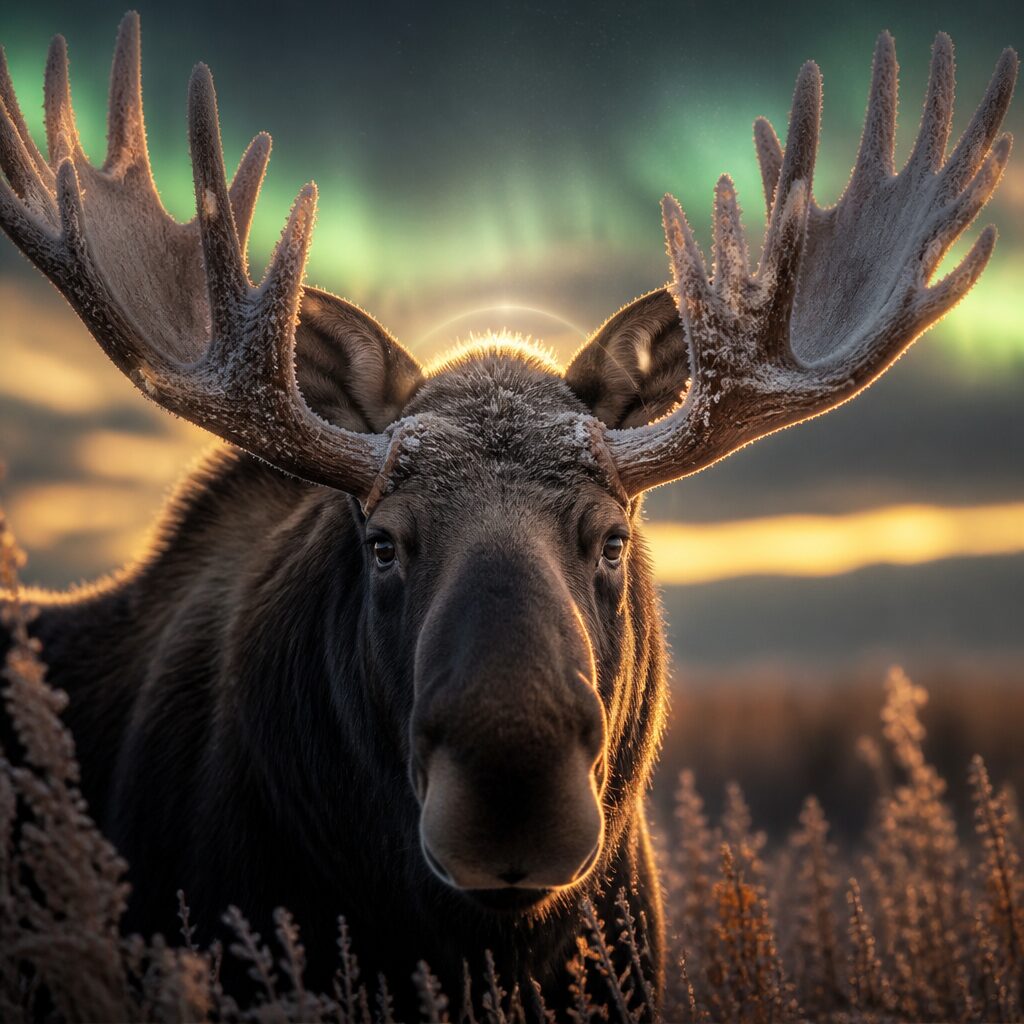
The moose is an animal of dawn and dusk. It is most active in the liminal hours — twilight, the threshold between worlds. If you want to connect with its energy, those are the optimal moments. Go outside when the day is turning. Stand still. The moose does not respond to noise or hurry. It responds to patient presence.
One practice tied to moose medicine is an honest energy audit. Sit with a piece of paper and write: where am I spending my strength? How much of what I do each day actually matters, and how much is inertia, empty obligation, or people-pleasing? The moose is extraordinarily efficient — it does not waste a calorie it does not need to burn. That same economy applied to your emotional and practical life is transformative.
In dreams, a moose walking calmly signals that your current pace is right — you do not need to accelerate. A moose charging toward you may indicate that something in your life requires immediate, direct action rather than further reflection. And a moose losing its antlers is one of the clearest dream images the animal world offers: something you used to define yourself has completed its cycle. It is time to let go.
700 pounds of silence
A fact that sounds impossible but is real: an animal weighing over 1,500 pounds can move through the forest without making a sound. Rangers in Alaska describe moose appearing from nowhere — one moment there is nothing between the trees, the next there is a creature the size of a horse staring at you from less than thirty feet away. No creak. No snapped branch. As if the forest itself had materialized them.
That is what the moose teaches in its most distilled form. That real power does not need to announce itself. That you can be the largest presence in the room and still move without making noise. That the most formidable strength is the kind that needs to prove nothing to anyone — it simply exists, walks, feeds on what others discard, releases what no longer serves it, and keeps moving at a pace that is neither fast nor slow, but exactly what it needs to be.