
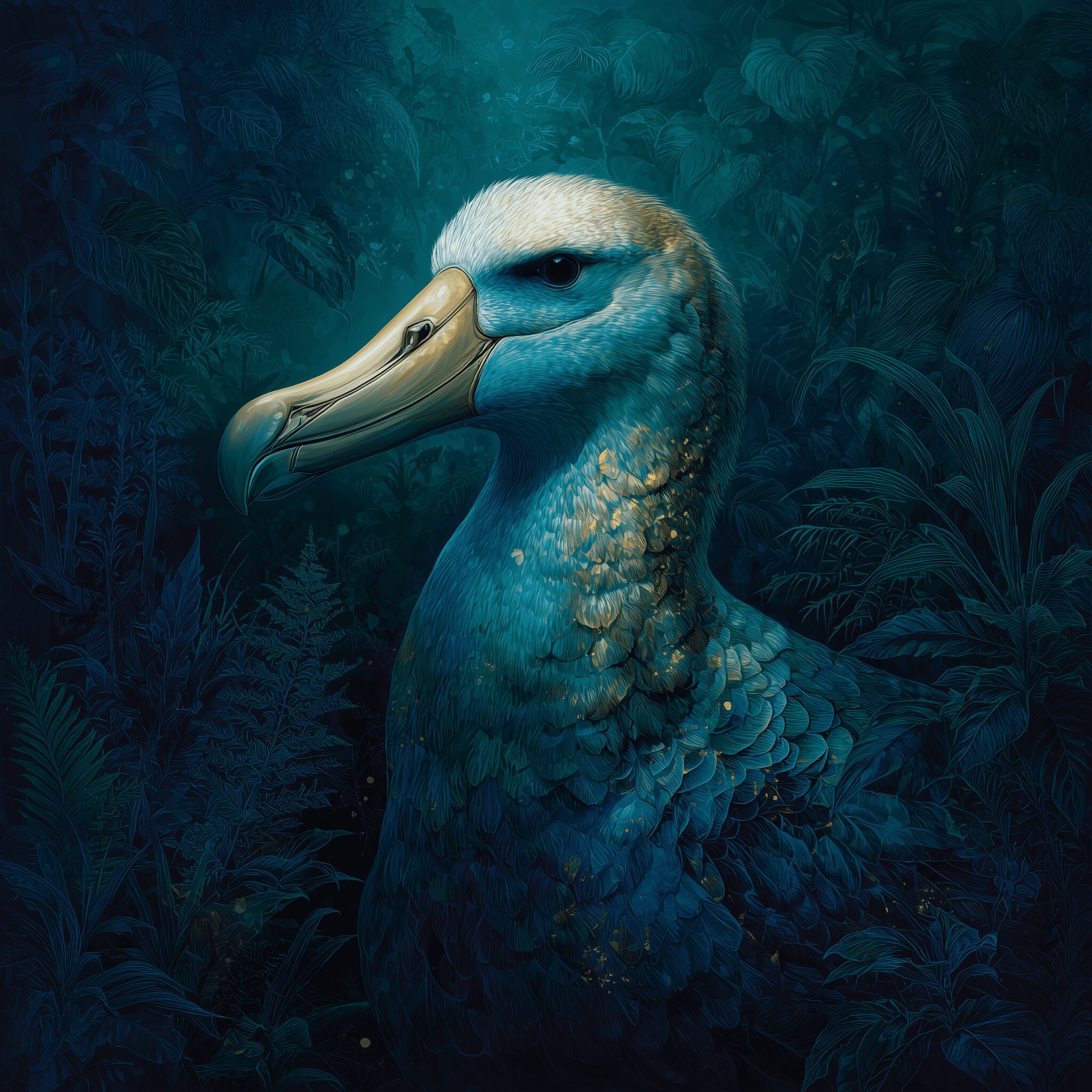

What went with the albatross: a Laysan chick on Midway Atoll, 2009. Chris Jordan photographed it open. Inside its stomach were one hundred and three pieces of plastic. Bottle caps, lighters, fragments of bags, a toy soldier. Its parents had flown thousands of miles across the Pacific to feed it, collecting from the ocean’s surface whatever looked like food. They fed it garbage with the same devotion they would have given squid. The chick died with a full stomach and a body empty of nutrients.
There is something in that image that won’t let you go. A bird that has dominated the oceans for fifty million years — fifty million, before the Andes existed, before the Mediterranean dried up and filled again — killed by the waste of a civilization with two hundred years of industrialization behind it. And the parents, who can fly twelve thousand miles on a single foraging trip, who can smell food from miles away, who are arguably the most sophisticated birds on the planet in terms of oceanic navigation, could not tell the difference between a squid and a Bic lighter.
If the albatross is calling to you, it is not inviting you on a poetic flight over the sea. It is asking you to look at what it truly costs to fly.
Toroa, Ahodori, and the Sailor Who Shot
For the Māori of Aotearoa — New Zealand — the albatross is toroa, and it is no ordinary bird. It is a kaitiaki, a spiritual guardian. In Māori cosmology, kaitiaki are entities that protect people, places, and natural resources. The toroa is kaitiaki of the open ocean, of the deep waters where ships grow small and horizons swallow every certainty. Māori navigators — who crossed the Pacific in waka hourua, double-hulled canoes, centuries before Europeans knew the Pacific existed — read the albatross’s presence as signal. If the toroa flew in a certain direction, it indicated currents, weather, the proximity of land. This was not superstition. It was a navigation system built on decades of observing an animal that knows the ocean better than any human instrument.
In Hawai’i, the Laysan albatross is called mōlī. Every November, more than a million pairs return to Midway Atoll — the same place where plastic-fed chicks die — to mate, nest, and raise young. They have done so for millennia, long before Midway was a U.S. naval base, long before the 1942 battle. Hawaiians associated the mōlī with the god Lono, deity of fertility, agriculture, and peace. The albatross’s arrival coincided with the Makahiki season, the four-month period when wars ceased and abundance was celebrated. The albatross did not bring the peace. It announced that peace was already here.
Cross the Pacific to Japan and the story darkens. The Japanese called the short-tailed albatross ahodori: the fool bird. Not out of contempt, but from a lethal observation — on land, the albatross is clumsy. Its legs are too short, its wings too long, its body designed for air and sea, not for solid ground. The feather hunters of the Meiji era discovered they could walk up to a perched albatross and club it to death. It did not flee. It could not. Between 1887 and 1903, hunters killed more than five million short-tailed albatrosses on Torishima Island to supply the European market for hat feathers. Five million. The species was reduced to fifty individuals. The bird that rules the skies of the entire planet, driven nearly to extinction because on land it cannot run.
And then there is Coleridge. In 1798, Samuel Taylor Coleridge published The Rime of the Ancient Mariner, and with it engraved the albatross into the Western imagination forever. A mariner kills the albatross that guided the ship through the fog. As punishment, the crew hangs the dead bird around his neck. The ship stalls. The water rots. The men die one by one. And the mariner is left alone, with the weight of the rotting bird against his chest, condemned to tell his story to every stranger he meets. “An albatross around your neck” became the Western metaphor for the burden you bring upon yourself by destroying what protected you. Coleridge never saw an albatross — he wrote the poem from accounts by Captain James Cook and the explorer George Shelvocke — but he captured something real sailors already knew: killing an albatross brings ruin. Not through magic. Because destroying the animal that tells you where the food is, where the storm is, where the land is, is an act of stupidity so profound it can only be called a curse.
A Flying Machine That Never Needs to Flap
The wandering albatross — Diomedea exulans — has the largest wingspan of any living bird: eleven and a half feet tip to tip. But that is only the headline figure. What truly matters is what it does with those wings: it flies without flapping.
The technique is called dynamic soaring. The albatross exploits the difference in wind speed between the ocean surface — where friction slows the air — and the higher layers — where it blows at full force — to generate lift without spending muscular energy. It climbs into the wind, turns, descends with the wind, turns again. An infinite cycle that drives it to speeds of up to seventy-five miles per hour without moving a single wing muscle. Its heart rate in flight is virtually identical to its resting rate. For an albatross, flying is as effortless as sleeping.
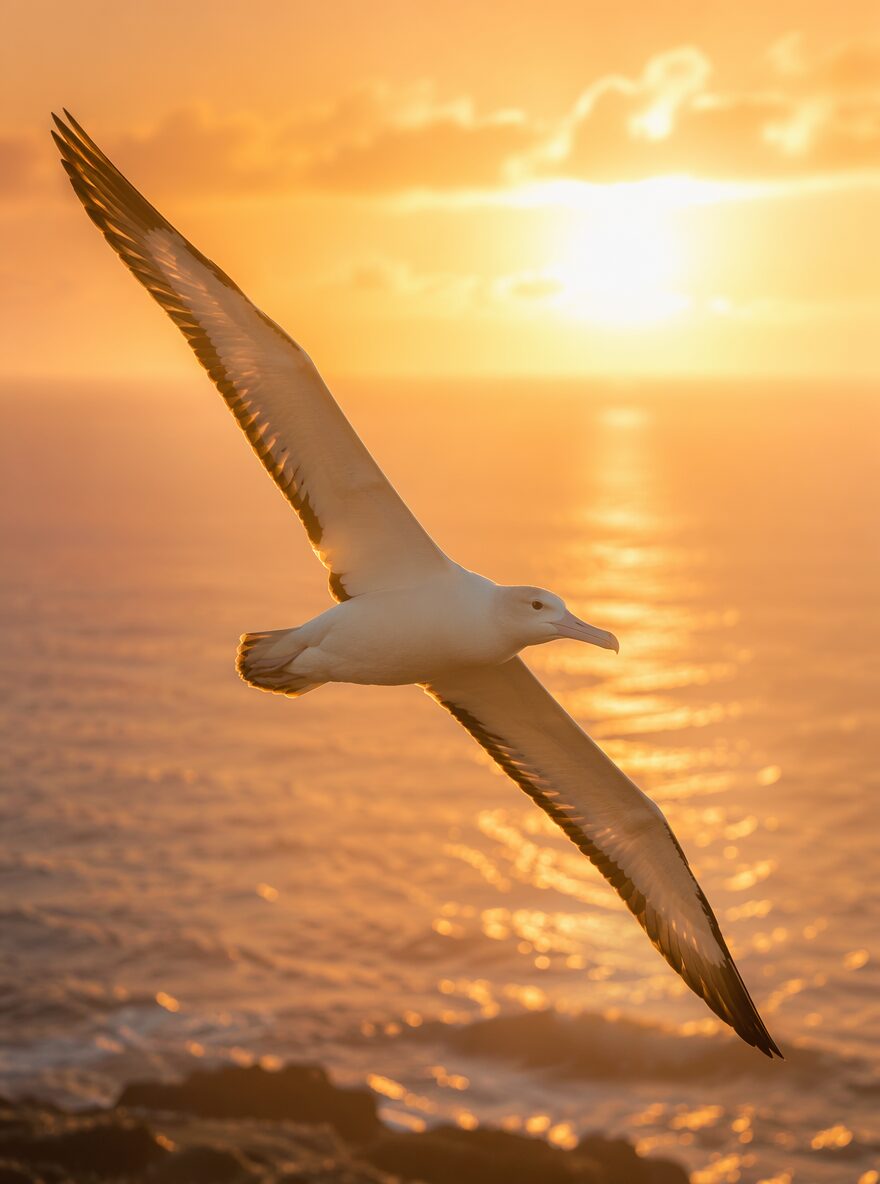
It has a tendon in the shoulder that locks the wings in the extended position, like a mechanical latch. It does not need to exert force to keep its wings open. They lock in place, and stay there. Aeronautical engineers have studied this mechanism for decades, attempting to replicate it in drones and unmanned aircraft. None has matched the albatross’s efficiency.
An albatross can circumnavigate the planet in forty-six days. It can fly six thousand miles in a straight line without stopping. It can spend the first five or six years of its life without touching land — literally living in air and water, sleeping on waves, eating from the ocean’s surface. And when it finally lands, it returns to the exact same square yard of beach where it was born, guided by an internal navigation system that combines Earth’s magnetic field, smell, sun position, star patterns, and wave memory. If you think about it for more than three seconds, it is absurd. An animal with a brain the size of a walnut navigates with more precision than any GPS.
Wisdom: Seventy-Four Years and Counting
In 1956, ornithologist Chandler Robbins banded a female Laysan albatross on Midway. He put band 587-51945 on her left leg. They named her Wisdom. In 2024, Wisdom was at least seventy-four years old. She is the oldest known wild bird in recorded history. She has survived tsunamis, Midway’s contamination, the plastic crisis, military occupation, everything. And she is still breeding. She has laid at least thirty-six eggs over her lifetime. Her last documented chick hatched when she was over seventy years old.
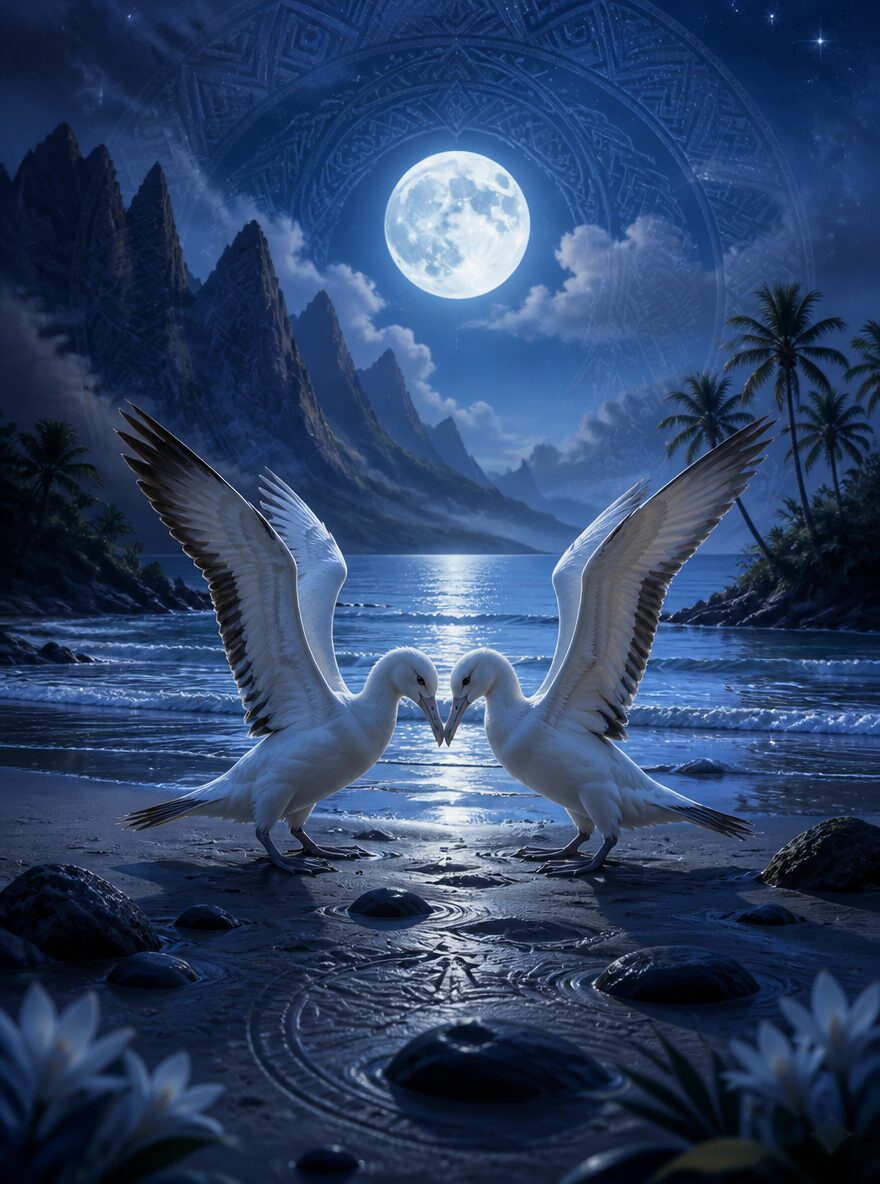
Consider the scale. Wisdom was born during the Eisenhower administration. She has flown an estimated three million miles — enough to travel to the Moon and back six times. She has seen her first mate die and found new ones. She has returned every November to the same nest, on the same island, for seven decades. And each time she returns, she performs the same courtship dance: an elaborate choreography of bows, bill claps, calls, and head movements that can last for hours, that takes years to perfect, and that is unique to each pair.
The albatross mates for life. But “for life” does not mean what you might think. It is not an instant decision. A young albatross spends years — literally years — learning to dance. It rehearses with multiple partners, tests sequences, fails, adjusts. It is like learning a body language composed of dozens of movements that must synchronize perfectly with another individual. And when two albatrosses finally sync their complete dance, they choose each other. For good. They reunite each season in the same place, raise young together, take turns incubating the egg for months, and share the feeding of the chick for nine months until it can fly. If one dies, the other may take years to re-pair. Or never do so at all.
The Shadow of the Albatross: When Flying Becomes Being Unable to Land
The Japanese ahodori was not foolish. It was an animal so perfectly adapted to flight that it became defenseless on land. And that is precisely the shadow of the albatross as a power animal.
When the albatross’s medicine falls out of balance, it produces a being who cannot stop moving. Who confuses perpetual flight with freedom. Who feels alive only in transit, only in the air, only when the horizon is far away and there is no need to negotiate with the concrete reality of a fixed place, a stable relationship, a commitment that requires landing.
The person in the albatross’s shadow is the one with a spectacular résumé and no roots. The one who has lived in eight cities in ten years and has no one who knows their childhood nickname. The one who falls in love with the idea of people but suffocates when the relationship demands constant presence. The one who mistakes depth for the accumulation of experiences. Many miles logged, very little ground underfoot.
The other face of that shadow is the burden. Coleridge’s albatross. The person who made a mistake — a betrayal, an abandonment, a word that should never have been said — and has worn it around their neck for years. Who turns guilt into identity. Who punishes themselves by flying without rest, without allowing themselves to stop, because stopping would mean sitting with what they did, and that hurts more than any storm.
And the quietest shadow of all: the plastic. The albatross feeding its chicks garbage it believes is food. The person who gives to others — to their children, their partner, their team — what they believe is valuable, without realizing they are passing on their own unprocessed waste: fear dressed as caution, control dressed as care, anxiety dressed as responsibility. Feeding with the best intentions while poisoning with what has never been digested.
The albatross’s shadow question is brutal: does your flight have a destination, or is it an elegant way to flee? Is what you are giving to those who depend on you nourishment — or plastic?
How to Work with Albatross Medicine
Learn to read the wind before you take off. The albatross does not launch into flight impulsively. It waits for the right gust, the exact direction, the moment where minimum effort produces maximum result. If you are at a point in your life where you feel you need to move — to change jobs, cities, relationships — albatross medicine does not tell you to do it now. It tells you to read the currents first. To distinguish between the genuine impulse to move forward and the anxiety of escape.
Practice the return. The albatross flies millions of miles, but it always comes back to the same place. The albatross’s freedom is not the wanderer’s aimless drift. It is the navigator’s freedom — the one who knows exactly where home is and chooses to return after every voyage. If albatross medicine is calling you, you need an anchor. A place, a person, a practice to which you always return. Without that fixed point, flight becomes drift.
Work the patience of courtship. The albatross takes years to perfect its dance. Deep relationships are not built in a weekend or through an app’s matching algorithm. They are built through the patient repetition of gestures, through constant adjustment to another person’s rhythm, through the willingness to try again at synchronization when it fails. If you tend to abandon relationships when they stop being easy, the albatross is showing you that ease is not the criterion. Synchronization is. And synchronization is earned with time.
Process your plastic. Before you give advice, before you care for others, before you feed people what you think they need, examine what you are carrying that is not yours. What inherited fears, what automatic patterns, what emotional debris you are mistaking for nourishment. The albatross at Midway cannot tell a squid from a lighter. You can — if you take the time to look at what you are carrying before you offer it.
Five Million Miles Back to the Same Nest
Every November, when the Southern Hemisphere begins to warm, Wisdom returns to Midway. She has flown perhaps fifty thousand miles since the last time. She has crossed storms that would sink ships. She has slept on thirty-foot swells. She has fed in waters barely above freezing. And when her feet touch the sand of that mile-and-a-half-long island, she does what she has done for seven decades: she finds her nest, waits for her mate, and dances.
There is nothing foolish in that. There is something most human beings never manage in an entire lifetime: the capacity to travel as far as you need and know exactly where home is. To be absolutely free and absolutely committed at the same time. To carry the weight of the whole ocean and keep dancing.
If the albatross is calling to you, it is not asking you to fly higher or farther. It is asking you to find your Midway. That place — physical or emotional — that is always worth returning to. And to learn to dance. Not because it is easy, not because it is fast, but because some dances take a whole lifetime to perfect, and that is precisely the point.